

500L vs 1000L vs 2000L: Which Water Tank Capacity Do You Actually Need?
Posted on: Sep 02, 2026
Introduction: Matching Water Tank Capacity to Daily Consumption
Why Sizing Your Storage Correctly Prevents Refill Delays and Water Stagnation
Choosing an overhead or loft water storage unit usually feels like a split-second decision during construction or renovation. Most property owners either buy whatever size the local plumber suggests or assume that bigger is automatically better.
In reality, misjudging your Water Tank Capacity leads to two frustrating extremes. An undersized tank causes constant refill delays, dry taps mid-shower, and excessive wear on your booster pump. On the flip side, installing an excessively large tank causes water stagnation. When large volumes of water sit idle for days under the hot sun, residual chlorine dissipates, temperatures rise, and the tank turns into an active incubator for microbial biofilms and algae. Precision sizing is the only way to ensure steady supply pressure while preserving freshness.
Evaluating Daily Per Capita Water Usage in Indian Households
According to standard Indian civic benchmarks (such as IS 1172 standards), the average daily domestic water requirement in urban households is roughly 135 to 150 liters per head per day (LPHD). This daily volume covers drinking, cooking, bathing, flushing, and washing.
When planning your primary overhead water storage, multiplying your head count by this per-capita baseline gives you a reliable starting figure:
- Drinking & Cooking: ~10–15 liters
- Bathing & Personal Hygiene: ~55–65 liters
- Flushing & Sanitation: ~30–40 liters
- Dishwashing & Laundry: ~25–30 liters
Sizing Guide: Evaluating Water Tank Capacity Options (500L vs 1000L vs 2000L)
500L Capacity: Ideal for Nuclear Families (2–3 Members) and Loft Storage
A 500-liter overhead storage tank fits small households, individual floors, or compact apartments housing 2 to 3 people. If your residential layout receives daily, dependable municipal pumping, a 500L Water Tank Capacity provides roughly a 24-to-36-hour supply buffer without demanding major roof or loft reinforcement. It also functions well as an indoor emergency loft tank or a dedicated drinking water reserve tied straight to an RO purification unit.
1000L Capacity: The Gold Standard for Joint Families (4–7 Members) & Small Commercial Units
The 1000-liter capacity remains the most popular domestic benchmark across India. For a standard family of 4 to 6 people, a 1000L tank comfortably covers 24 to 48 hours of uninterrupted water use. It easily handles simultaneous morning routines, washing machine cycles, and unexpected guests without draining completely before the evening pump cycle. It also suits small commercial establishments, boutique offices, clinics, and ground-floor cafes where consistent daytime water pressure is non-negotiable.
2000L Capacity: Built for Large Estates, Hostels, and Industrial Sites
When dealing with extended joint families, multi-unit builder floors, student hostels, homestays, or light industrial workshops, a 2000-liter setup is essential. At this operational scale, water outages disrupt multiple daily workflows. A 2000L tank cushions your property against erratic 48-hour municipal supply schedules while maintaining steady head pressure across multi-level bathroom plumbing.
Material Standards: Ensuring You Buy the Best Quality of Water Tank
Seamless Rotational Moulding vs. Thin-Walled Blow Moulded Alternatives
Volume is only half the equation; structural durability matters just as much. To secure the best quality of water tank, always check how the unit was fabricated.
Cheap mass-market containers frequently use high-speed blow moulding. This process often yields non-uniform wall thickness, leaving paper-thin structural zones at corners and base radii that crack under cyclic hydraulic loads. In contrast, advanced Rotational Moulding (Roto-Moulding) uses bidirectional rotational heating to form a seamless, single-piece tank with uniform wall thickness and zero weak joint lines.
Multi-Layer Thermal Protection: Keeping Water Cool During Extreme Summers
A high-performance tank requires specialized multi-layer defense:
- Outer UV-Shield Layer: Compounded with high-grade carbon black or titanium dioxide UV stabilizers to stop the polymer from becoming brittle under harsh sun.
- Thermal Insulation Foam Core: Specialized middle foam layers resist extreme ambient heat, keeping tap water cool during peak summers instead of scalding hot.
- Structural Ribbed Body: Circumferential ribs resist lateral hydraulic expansion, preventing the tank walls from bulging when filled to capacity.
Bio-Security: The Role of a Food Grade Water Tank in Drinking Safety
Why Virgin LLDPE Polymer Matters for Long-Term Drinking Safety
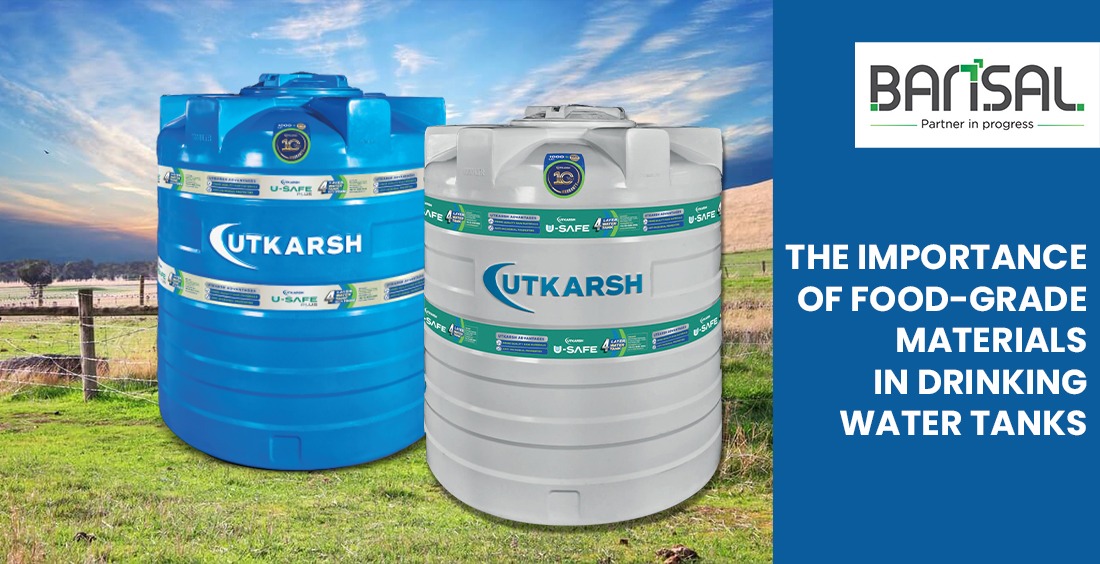
A certified food grade water tank must be manufactured using 100% virgin Linear Low-Density Polyethylene (LLDPE). Substandard manufacturers cut costs by blending recycled regrind plastics into their middle layers. These recycled materials often contain toxic chemical residues, heavy metals, and plasticizers that leach into your water supply, altering its taste, smell, and chemical purity. 100% virgin polymer is chemically inert, non-reactive, and completely safe for potable storage.
Anti-Bacterial and Anti-Algae Inner Linings for Odor-Free Water
Even with virgin plastic, stagnant water exposed to indirect sunlight can develop bacterial biofilms and black algae. Premium tanks integrate an anti-microbial, anti-algae inner lining. These smooth, food-safe coatings actively inhibit bacterial colonization on internal surfaces, making regular maintenance straightforward and keeping your water odor-free.
Key Sizing Checklist: Factors Beyond Household Size
Municipal Water Supply Frequency: Daily vs. Alternate-Day Pumping
If your municipality pumps water for two hours every morning, a standard 24-hour capacity calculation works fine. However, if your locality relies on alternate-day supply or unpredictable water tankers, always calculate your storage for a 48-hour buffer (multiplying your daily requirement by 2) to prevent mid-week shortages.
Rooftop Load Bearing Capacity and Plumbing System Constraints
Water is heavy. A 1000L tank adds approximately 1,000 kg (1 metric ton) of static load to your rooftop slab, while a 2000L tank adds over 2 metric tons.
- Always place large tanks directly over structural load-bearing beams or reinforced concrete columns.
- Ensure the base platform is completely flat, level, and free of masonry debris to prevent concentrated point loads from cracking the tank bottom.
- Account for adequate elevation above your topmost fixtures to guarantee sufficient gravity-fed water pressure.
Conclusion: Invest in Safety with Bansal Poles Water Storage Tanks
Final Sizing Summary: Finding Your Ideal Balance of Capacity and Safety
Sizing your water storage requires balancing your family head count, municipal supply patterns, and roof structural limits. A 500L tank serves nuclear setups or loft needs, 1000L provides the ideal all-around family baseline, and 2000L delivers robust security for larger estates and commercial properties.
Why Bansal Poles Delivers High-Durability, Food-Grade Water Tanks
When you choose a Bansal Poles Water Tank, you invest in uncompromised engineering and material purity. Built under strict ISO 9001:2015 quality standards and compliant with IS 12701 specifications, every unit is crafted from 100% virgin LLDPE polymer using state-of-the-art Roto-Moulding.
With multi-layer UV stabilization, anti-microbial food-grade inner linings, heavy-ribbed structural bodies, and an automatic built-in capacity buffer, Bansal Poles delivers the best quality of water tank solutions designed to keep your family’s water safe, cool, and clean for decades.
Frequently Asked Questions
Multiply the number of regular residents by 135–150 liters (standard Indian per capita daily consumption). For a 4-member family, 4 × 150 = 600 liters per day. Adding a 20–30% safety cushion for supply interruptions makes a 1000L overhead tank the ideal choice.
A food grade water tank uses 100% non-recycled, virgin LLDPE polymer that is chemically inert. This ensures no microplastics, toxic plasticizers, or chemical odors leach into your water, making it safe for drinking, cooking, and bathing.
Look for seamless Roto-Moulded construction, full IS 12701 compliance, 100% virgin food-grade resin certification, multi-layer UV stabilization, deep external structural ribbing, and airtight threaded inspection lids.
Yes, provided your area receives dependable daily municipal water supply. If supply is intermittent or alternate-day, upgrading to a 1000L tank provides a safer 48-hour reserve.
A filled 2000L tank weighs roughly 2,000 kg. When placed on a flat, masonry-supported platform directly above structural beams or pillars, standard reinforced concrete roofs easily support this static load. Avoid placing heavy tanks on unsupported cantilever slabs.
Comments (0)
Post Your Comment