
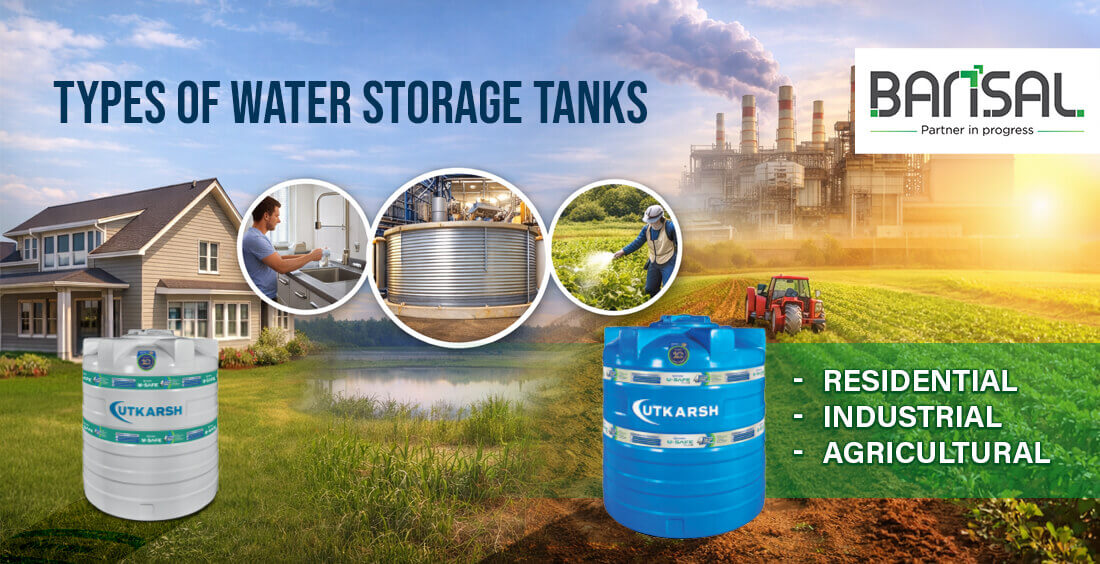
Types of Water Storage Tanks: Residential, Industrial & Agricultural
Posted on: Feb 24, 2026
Summary
Water storage tanks are used in homes, industries, and farms. However, each use requires a different type of tank. In this blog, we explain the types of water tanks based on application.
Water is the rhythm of our daily lives. It powers our morning showers, cooks our food, keeps factories running, and sustains crops. But in many parts of the country, relying solely on the municipal supply is a gamble. Pipelines burst, maintenance schedules drag on, and summer shortages are practically a tradition. That is why a reliable water storage tank isn't just a container; it's your backup plan. It ensures that life, work, and farming continue without disruption.
What Are the Different Types of Water Tanks?
At its simplest, a water storage tank is a reservoir that holds water for the future. It acts as a buffer between the unpredictable supply from the city or a borewell and your immediate need for water.
But "storage" means different things to different people. For a homeowner, storage means hygiene - ensuring the water is safe to drink. For a factory manager, storage means durability - a tank that won't crack under stress. For a farmer, it means weather resistance. To help you navigate these options, we can categorize the main types of water tanks into three buckets: Residential, Industrial, and Agricultural.
Let’s break down what makes each one unique.
1. Residential Water Tanks: Hygiene Starts Here
If you live in an independent house, an apartment complex, or a housing society, you are looking for a residential water tank. This is likely the most important appliance in your home because it holds the water you use for cooking, bathing, and drinking.
The Priority: Safe, Clean Water
In a residential setting, health is the top priority. You don't want a tank that encourages algae growth or leaches chemicals into your water. This is why modern residential tanks are typically made from food-grade virgin plastic.
Unlike recycled plastic, which can sometimes carry contaminants, virgin plastic ensures that the water remains hygienic. When you look at Bansal Poles water tanks, they are manufactured using roto-moulding technology. This sounds technical, but the benefit is simple: the tank is made in one single piece. There are no seams, no joints, and no glued parts. A seamless body is much stronger and virtually eliminates the risk of leakage, which is the last thing you want leaking through your ceiling.
Sizing for Homes
Residential tanks usually come in small to medium capacities - typically 500 to 1000 liters. These sizes are ideal because they are lightweight and easy to install on a roof or a loft without requiring a crane or massive structural reinforcement. Whether you are in a single-family home or managing a housing society, these tanks serve as the perfect bridge between irregular municipal supply and your daily needs.
2. Industrial Water Tanks: Built for the Grind
Now, let's look at the commercial side. Compared to other types of water tanks, industrial versions operate in a completely different environment. In manufacturing units, warehouses, and commercial buildings, water isn't just for washing hands - it’s often part of the production process, cooling systems, or fire safety protocols.
Durability Over Volume
There is a common misconception that "industrial" always means a massive, swimming-pool-sized reservoir. While that is true for heavy industry, most small-to-medium businesses need reliable, high-strength auxiliary tanks (500L - 1000L) for specific stations.
These tanks need to handle "rough use." They might sit in a hot warehouse or exposed to chemical fumes. Key characteristics here include a robust outer structure and a design meant for continuous cycling - filling and emptying multiple times a day.
Why Plastic Beats Metal in Industry
Years ago, industries relied on metal tanks. The problem? Rust. Once a metal tank starts corroding, it contaminates the water and eventually springs a leak. Plastic industrial tanks have become the standard because they are chemically inert - they do not rust.
Bansal Poles takes this a step further with UV-stabilized plastic. If your factory needs a tank installed outdoors or in a semi-open shed, UV stabilization is non-negotiable. It prevents the plastic from becoming brittle and cracking under the sun. Plus, the smooth inner surface prevents algae and bacteria from clinging to the walls, keeping maintenance downtime to a minimum.
3. Agricultural Water Tanks: Weathering the Elements
Farming is one of the toughest professions, and it is entirely dependent on water. An agricultural water tank isn't a luxury; it's an asset that supports irrigation and livestock.
The Challenge of Uncertainty
Farmers know that rainfall is rarely predictable. A dry spell at the wrong time can ruin a harvest. While huge reservoirs are used for field irrigation, farmers rely on transportable, durable tanks (like the 500L-1000L range) for critical tasks like:
- Livestock water supply: Providing drinking stations for cattle in remote corners of the farm.
- Mixing stations: Safely mixing fertilizers or feed away from the main water source.
- Drip Irrigation: Acting as a header tank for precise watering in greenhouses or nurseries.
Why Farmers Choose Plastic
In the past, farmers had to build concrete cisterns. These were immovable and cracked as the ground shifted. Plastic tanks, on the other hand, are easy to transport. You can throw a 500L tank on the back of a truck and move it to where the cattle are grazing today.
Since these tanks sit out in open fields under the baking sun, Bansal Poles designs them to resist sunlight damage and cracking. They are built to survive the outdoors, making them a one-time investment for long-term farm use.
Comparing Types of Water Tanks: Plastic vs. Concrete
We’ve talked about usage, but let's talk about material. When evaluating different types of water tanks, the market is generally split between concrete and plastic.
Concrete Water Tanks: You probably remember these from older buildings. They are heavy, permanent structures often built underground. While they are strong, they have major downsides: they are prone to cracking, roots can grow into them, and cleaning them is a difficult, claustrophobic task.
Plastic Water Tanks: This is where the industry has moved. Plastic tanks are lightweight, rust-free, and incredibly easy to handle. But the biggest advantage is hygiene. A high-quality plastic tank is food-grade and non-porous, meaning bacteria has nowhere to hide.
Bansal Poles uses 100% virgin plastic. Recycled plastic might be cheaper, but it is weaker and potentially unsafe. Virgin plastic is stronger, more flexible, and guaranteed safe for water storage. That is why plastic tanks are the smarter choice today - they cost less in the long run and offer better safety.
How to Choose the Right Water Storage Tank
So, you know you need a tank. How do you pick the right one? It’s not just about buying the biggest one you can find. It depends on your space and your specific needs.
Here is a quick checklist to run through before you buy:
- Analyze Your Consumption: How much water do you actually need? A small family might be fine with 500L, while a busy restaurant or farm will need multiple 1000L units.
- Check the Space: Measure the area where the tank will go. If it’s an indoor loft, height matters. If it’s a roof, footprint matters.
- Location: Is it going indoors or outdoors? If it's going on the roof (outdoors), you must ensure the tank is UV-resistant to handle the sun.
- Material Integrity: Don't settle for cheap plastic. Ensure it is virgin, food-grade material.
Why Choose Bansal Poles?
When it comes to water storage, quality matters. Bansal Poles water tanks are made from 100% virgin, food-grade plastic to ensure strength and hygiene. The seamless roto-moulded design prevents leakage and improves durability. In addition, UV-stabilized material protects the tank from harsh sunlight, making it ideal for Indian conditions. Whether for home, industry, or farm use, Bansal Poles offers reliable performance and long-term peace of mind.
Conclusion: Peace of Mind in a Tank
Water scarcity isn't going away; in fact, it’s becoming a bigger challenge every year. Having the right type of water tank is about more than just convenience - it’s about security. It ensures that when the city's supply cuts off, your day doesn't stop.
Whether you are running a home, a business, or a farm, the storage solution you choose matters. It affects the health of your family and the efficiency of your work. Modern solutions like Bansal Poles' virgin plastic tanks offer that perfect balance: they are built for the harsh Indian climate, they keep water safe, and they are built to last.
When you choose the right tank, you aren't just storing water. You are protecting it for the future.
Frequently Asked Questions
The three main types of water tanks are residential (for homes), industrial (for businesses/factories), and agricultural (for farming and livestock).
They are manufactured using 100% virgin, food-grade plastic rather than recycled materials, which ensures better strength and safety.
Yes, absolutely - provided you choose the right plastic. Food-grade virgin plastic tanks are designed specifically to be hygienic and safe for drinking water.
Yes. These tanks are made with UV-stabilized plastic, meaning they are engineered to sit in direct sunlight without degrading or cracking
Look at your daily water usage, the space you have for installation, and whether you need it for home or commercial use. Capacity and material quality are your two biggest deciding factors.
Comments (0)
Post Your Comment