
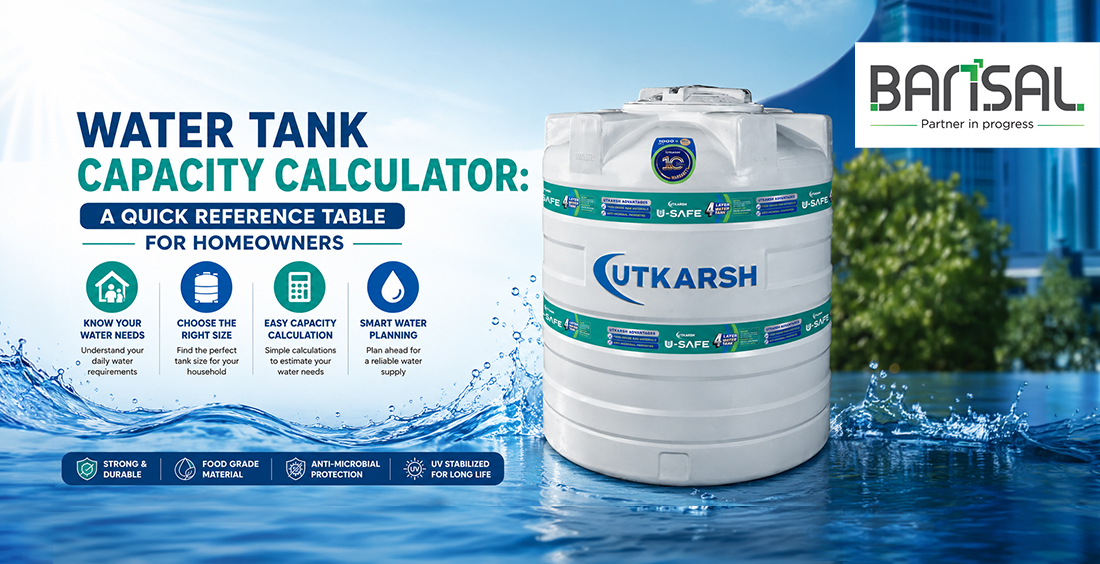
Water Tank Capacity Calculator: A Quick Reference Table for Homeowners
Posted on: Jun 02, 2026
Choosing the Right Water Tank Size Isn’t About “Bigger is Better”
Choosing a water tank for home use always feels like a bit of a guessing game. Most homeowners walk into a store and blindly pick a massive tank that wastes valuable roof space, or they end up with a small one that runs completely dry during the morning shower rush.
There is a very common myth in Indian households that "bigger is always better" when it comes to water storage. Let’s debunk that right now. Opting for an oversized tank doesn't mean you are being extra prepared; it usually means you are creating a home for stagnant water. In our tropical climate, standing water quickly turns into a major breeding ground for dangerous bacteria, fungus, and algae. Storing the right amount of water is just as critical as choosing the best quality of water tank to safeguard your family’s daily health.
The Indian Standard: How Much Water Does One Person Need?
To clear up the confusion, we do not need to rely on guesswork. We can look directly at the official Bureau of Indian Standards (BIS). According to Indian standard IS codes (specifically IS 1172), the baseline metric for domestic water consumption is calculated at 135 to 150 liters per person per day (LPCD).
This standard baseline isn't a random number-it breaks down your complete daily domestic needs, including:
- Drinking & Cooking (approx. 5-10 Liters)
- Bathing & Washing Utensils/Clothes (approx. 55-65 Liters)
- Flushing & General Cleaning (approx. 40-45 Liters)
For a typical family of 4, the basic minimum math suggests a baseline requirement of roughly 600 liters of water every single day.
The 2026 Sizing Formula: Factoring in Peak Demand & Supply Buffers
- Daily Municipal Supply: If your area receives reliable municipal water every single day, the basic calculated capacity is perfectly sufficient.
- Alternate Day / Irregular Supply: If your water supply comes every other day or is notoriously irregular, you need to double your required storage capacity to build a solid 2-day backup buffer.
Quick-Reference Water Tank Capacity Guide
|
Family Size |
Daily
Baseline Need (Liters) |
Recommended
Size (Daily Supply + Buffer) |
Recommended
Size (Alternate Day Supply) |
|
2-3 Members (Small Family) |
300L - 450L |
500 Liters |
1,000 Liters |
|
4-5 Members (Standard Family) |
600L - 750L |
1,000 Liters |
1,500L -
2,000 Liters |
|
6-8 Members (Large/Joint Family) |
900L - 1,200L |
1,500L -
2,000 Liters |
3,000 Liters |
|
10+ Members (Multi-Gen / Commercial) |
1,500L+ |
2,500L -
5,000 Liters |
5,000L -
10,000 Liters |
Beyond Volume: Matching Sizing with the Best Quality of Water Tank
- Material Integrity: Ensure the tank is constructed using 100% Virgin Food-Grade Polyethylene. Avoid recycled plastics that leach harmful microplastics. The structure should be manufactured via seamless Roto-Moulding (Rotational Moulding), which creates uniform wall thickness and completely eliminates joint leaks.
- The Anti-Microbial Shield: Standing water in hot weather triggers dangerous microbial biofilms on the inner walls. Your drinking water tank must feature active anti-bacterial inner layers to permanently stop the growth of algae, fungus, and bacteria.
- Thermal Deflector Layers: Nobody likes hot water coming out of the bathroom tap during peak summers. High-quality multi-layered construction-featuring specialized insulation foam layers-is essential to keep internal water temperatures stable.
The Bansal Poles Advantage: Engineered to Give You More
With a rich 40-year engineering legacy in building durable industrial and residential infrastructure, Bansal Poles Limited brings unparalleled precision to water storage. We don't just manufacture standard plastic shells; we engineer high-performance home assets.
The 10% Extra Buffer Value
We understand that life is unpredictable. That’s why Bansal Poles tanks are deliberately engineered with a 10% extra capacity buffer over the rated label. If you buy a 1,000-liter rated tank, you get an extra margin of safety built directly into the design. This saves you from being forced to buy a larger, much more expensive tank size just to get a small safety cushion.
Every single tank we make complies strictly with IS 12701 standards for rotational molded polyethylene tanks, ensuring heavy-duty structural ribbing, high tensile strength, and airtight threaded lids that keep out dust and pests for decades.
Explore our range of products on the official product page: Bansal Poles Water Tank.
Conclusion
Sizing your home water tank requires balancing your daily family habits, the reliability of your municipal supply, and available structural roof space. Stop playing a dangerous guessing game with your family’s daily hygiene and health. Take a look at the comprehensive range of water tanks to find the perfect capacity and elite protection for your home today.
Frequently Asked Questions
To find the right water tank capacity, multiply the number of family members by 135 or 150 liters (the official Indian standard baseline per day). Then, add a 10% to 20% safety margin for peak demand or unexpected guests. If your supply is irregular, double that capacity for a 2-day backup.
Yes, a 1,000-liter drinking water tank is typically the sweet spot for a standard Indian family of 4 to 5 members receiving daily water supply. It easily covers daily needs and provides a safe cushion for peak morning windows.
Installing an oversized tank of water leads to stagnant storage. In a warm climate, stagnant water breaks down your protection shield and becomes a prime breeding ground for harmful bacteria, algae, and fungus, threatening family health.
IS 12701 is the official Indian Standard benchmark for polyethylene water tank manufacturers. This certification guarantees that the tank has undergone rigorous hydrostatic testing, possesses uniform wall thickness, and meets national safety requirements for structural strength.
Bansal water tanks are built using advanced Roto-Moulding technology, 100% virgin food-grade material, and unique multi-layered defenses. Features like 100% UV protection and heavy structural ribbing ensure high impact resistance and stable water temperatures for years.
Bansal Poles water tanks are built with a 10% extra storage volume over their rated label capacity. This gives homeowners an automatic safety buffer for peak usage hours without making them spend more money on an unnecessarily larger tank size.
Comments (0)
Post Your Comment