
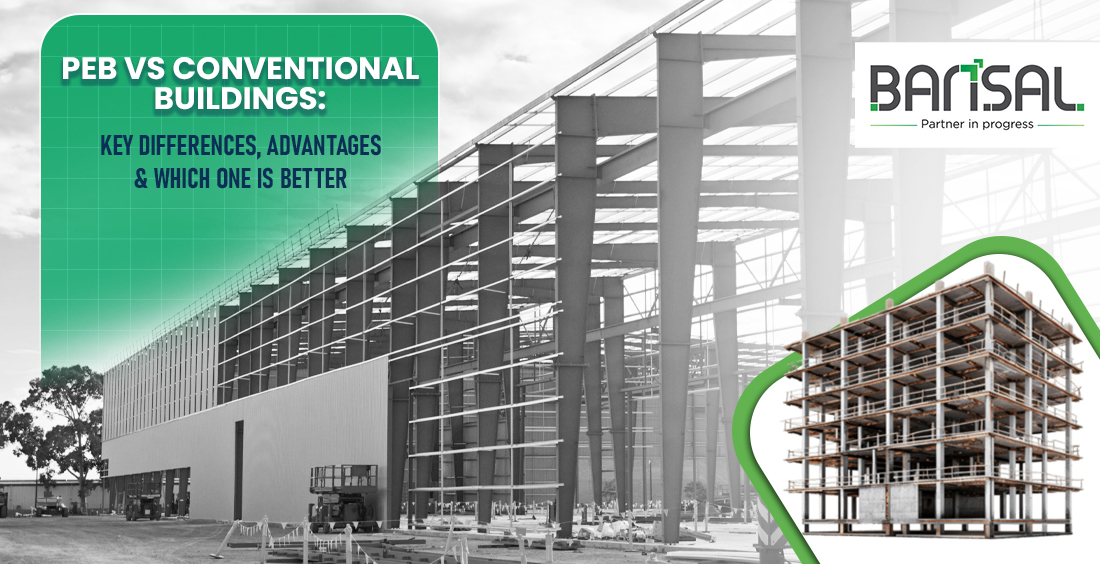
PEB vs Conventional Buildings: Key Differences, Advantages & Which One Is Better
Posted on: Mar 21, 2026
Summary
Choosing between a peb vs conventional building is a major decision for any project owner. This blog breaks down the key differences between these two methods. While conventional buildings use traditional onsite labor and materials like RCC, PEBs are designed and fabricated in a factory before being assembled onsite. You will learn about the speed, cost-effectiveness, and durability of PEBs compared to steel or concrete buildings. We also highlight why modern industries are switching to PEB solutions and how Bansal Poles Limited provides the highest quality structures in the market.
Modern Construction: Why Steel is Replacing Concrete
The choice between a peb vs conventional building will define the success of your next project. For many years, people only used traditional bricks and mortar. This meant hiring many workers and buying raw cement. However, things have changed. Today, the peb vs conventional building debate is at the heart of modern construction.
If you want a fast and strong structure, you need to understand these differences. A Pre-Engineered Building (PEB) offers a smarter way to build. It saves time and cuts costs. In this guide, we will show you why a peb vs conventional building comparison favors the modern steel approach. We will look at speed, quality, and the many advantages of pre-engineered buildings.
What is a Conventional Building?
Conventional buildings are what most people think of when they hear "construction." Workers build them from scratch at the project site. Usually, this involves Reinforced Cement Concrete (RCC) or traditional steel frames. Laborers cut, weld, and fit every piece on-site. This is a slow process. It relies heavily on the skills of the local workers. Because of this, the quality can vary from one day to the next.
What is a Pre-Engineered Building (PEB)?
A Pre-Engineered Building is a modern alternative. In this method, a manufacturer designs the entire structure using advanced software. The factory makes the columns, beams, and roof panels in a controlled environment. Then, the team ships these parts to the site. Workers simply bolt them together. It is like a giant, high-tech set made of high-strength steel. This is a major reason why the peb vs conventional building choice is becoming easier for business owners.
PEB vs Conventional Building: Key Differences
To understand the shift in the industry, we must look at the facts. Here is how a peb vs conventional building comparison looks in real-world terms.
- Design and Engineering: In traditional construction, the design phase takes a long time. Every project starts from zero. However, PEBs use specialized software that automates the design. This reduces human error. Since engineers do the work beforehand, the structural integrity is much higher.
- Construction Speed: Speed is a huge factor in the peb vs conventional building debate. Conventional buildings often take 6 to 12 months to finish. In contrast, a PEB project finishes in nearly half that time. The factory makes the parts while the team prepares the site. Once the parts arrive, the assembly is very fast. Therefore, you can start your business sooner.
- Cost-Effectiveness: Many people assume steel is expensive. But when you look at peb vs traditional construction, PEBs are often cheaper. You save money on labor because the assembly is quick. Also, there is no waste. In a conventional building, you often buy too much cement or sand. With a PEB, the factory accounts for every gram of steel. This makes the benefits of peb buildings clear for your budget.
- Flexibility and Expansion: Traditional buildings are hard to change. If you want to expand a concrete warehouse, you must break walls. This creates dust and noise. On the other hand, PEB buildings are modular. If you need more space, you just add more sections to the existing frame. It is clean, easy, and very fast.
The Top Advantages of Pre-Engineered Buildings
Modern businesses prefer steel for many reasons. Here are the primary advantages of pre-engineered buildings:
- Lightweight yet Strong: PEBs use high-strength steel. This makes the building lighter than concrete. Yet, it can handle high winds and earthquakes much better.
- Large Clear Spans: Do you need a warehouse with no pillars in the middle? PEB is the best choice. It allows for huge open spaces. This is perfect for moving forklifts and large machines.
- Low Maintenance: Steel buildings resist pests, rot, and fire. Modern coatings also prevent rust. This is a key reason for peb vs traditional construction shifts.
- Sustainability: Steel is 100% recyclable. Choosing PEB is a green choice. It has a much smaller environmental footprint than concrete.
Steel Building vs Concrete Building: A Quick Comparison
| Feature | Pre-Engineered Steel Building | Conventional Concrete Building |
| Foundation | Simple and lightweight | Heavy and expensive |
| Delivery Time | Very Fast (8-12 weeks) | Slow (6-12 months) |
| Architectural Choice | Modern and flexible | Traditional and limited |
| Earthquake Resistance | Excellent (Flexible steel) | Average (Brittle concrete) |
| Quality Control | High (Factory made) | Variable (On-site labor) |
Why Choose PEB Buildings for Industrial Use?
If you are building a factory or a warehouse, you want to start fast. Every month of construction costs you money. This is why choose peb buildings over any other method. They offer a "turnkey" experience. You get a clear timeline and a fixed budget. There are no hidden costs. Consequently, your project stays on track.
Furthermore, a peb vs conventional building comparison shows that steel handles industrial loads better. It lasts longer and requires fewer repairs over time.
High-Quality Solutions from Bansal Poles Limited
The quality of the steel matters most in a PEB. This is where Bansal Poles Limited excels.
Bansal Poles provides high-quality Pre-Engineered Building products. They design every structure to meet international standards. Their PEB systems include primary frames, secondary members, and strong roof cladding. Whether you need a small shed or a giant factory, their team ensures the structure is durable. Their use of high-grade raw materials makes them a leader in the peb vs conventional building market.
Why Bansal Poles PEB?
Choosing the right partner is vital for your project. At Bansal Poles, we provide complete solutions. Our PEB systems offer maximum efficiency. We use the latest technology to make parts that fit perfectly. Our structures are famous for resisting earthquakes and heavy rain. With years of experience, Bansal Poles guarantees fast delivery. We support you from the first design to the final bolt. This is why we are the top choice for anyone looking at the benefits of peb buildings.
Conclusion
In the battle of peb vs conventional building, the winner is clear. If you want a traditional house, concrete is fine. But for commercial and industrial projects, PEB is much better.
The advantages of pre-engineered buildings are too big to ignore. They offer speed, low costs, and massive strength. Why wait years for a building? You can have a superior steel structure ready in just a few months.
Frequently Asked Questions
Yes. Steel is flexible. PEBs bend slightly under pressure instead of cracking. This makes them safer than concrete buildings in seismic zones.
Yes. You can use different wall panels and glass windows. Your building will look modern and professional, not like a simple shed.
No. We use high-quality insulation. This keeps the inside cool. In fact, steel buildings with insulation are often more energy-efficient than brick ones.
Yes. Because the parts are bolted together, you can dismantle them. You can then move the building and put it up at a new site.
For industrial use, yes. Steel is faster to build, spans longer distances without pillars, and is easier to maintain than concrete.


Comments (0)
Post Your Comment