
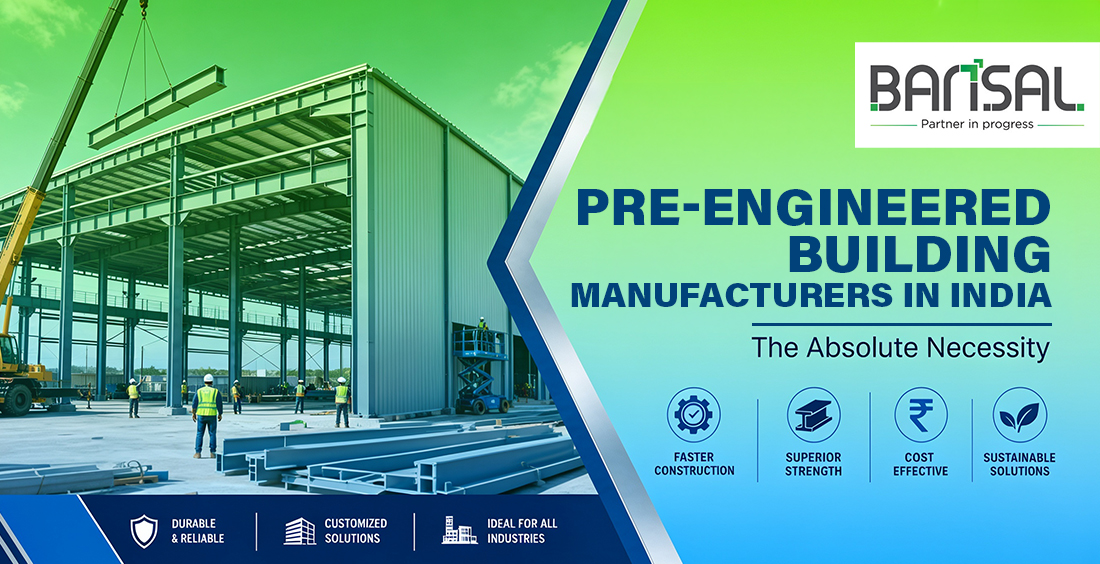
Pre Engineered Building Manufacturers in India: The Absolute Necessity
Posted on: Jun 16, 2026
The Shift: Modern commercial setups are abandoning traditional brick-and-mortar builds for Pre-Engineered Buildings (PEBs) to eliminate unpredictability, material waste, and seasonal delays.
The Advantage: Fabricating 100% of components off-site in controlled environments cuts overall project commissioning timelines by up to 50%.
The Blueprint: High-quality PEBs rely on precision-engineered primary framing, secondary members, and advanced climate-resilient cladding.
The Choice: Selecting an established partner ensures strict adherence to national guidelines like IS 800:2007 and IS 875, converting infrastructure into a secure, predictable, and scalable long-term asset.
What is a PEB, and Why is It Revolutionizing Indian Construction?
Walk through any major industrial zone in India today, and you will notice a massive shift in how structures go up. The old approach of pouring concrete on-site and dealing with endless delays is rapidly fading. Instead, modern commercial development relies heavily on Pre-Engineered Buildings (PEBs).
To put it in plain terms, a PEB is a structural system where the entire building is planned, designed, and fabricated inside a factory before any materials even touch the actual construction site. Once the components are ready, they are shipped directly to the location for final assembly.
As a leading peb manufacturer in India, we are seeing this technology redefine industrial infrastructure every single day. Traditional building methods are plagued by unpredictable material costs, weather disruptions, and sudden labor shortages. Moving the bulk of the heavy engineering from a messy field into an automated, controlled factory floor changes everything. This level of predictability and speed is exactly why major corporations are ditching old-school construction to embrace modern pre-engineered systems.
The Core Elements: Anatomy of a High-Quality PEB Structure
When top-tier pre-engineered building manufacturers talk about these buildings, they are not just talking about putting up a basic steel shell. They are talking about a highly coordinated, multi-layered system designed to handle immense stress. Here is what makes up the physical anatomy of a reliable PEB:
- Primary Structural Framing: This acts as the main backbone. It consists of heavy, built-up "I" sections, steel columns, and rafters that take on the primary weight loads and transfer them safely down to the concrete foundation.
- Secondary Structural Members: These provide crucial structural bracing. This layer includes cold-formed "C" and "Z" purlins, girts, and eave struts running perpendicular to the main frames to give the building its longitudinal stiffness and hold the wall panels in place.
- Advanced Roofing, Cladding, & Accessories: The outer protective layer utilizes high-tensile metal sheets, standing seam roof panels for complete leak protection, and insulated sandwich panels (like PUF blocks) for temperature control. Ridge ventilators and custom turbo-vents are added to keep air moving naturally.
For a clear understanding of the different types of PEB sheds, read our blog: https://bansalpoles.co.in/blog/types-of-peb-structures-and-their-applications
5 Reasons Pre-Engineered Building Manufacturers in India are an Absolute Necessity
1. Slashing Timelines with Parallel Processing
In the industrial sector, time literally equals money. If a project stalls, capital sits idle. Partnering with professional pre-engineered building manufacturers in India gives businesses a distinct logistical edge: parallel processing. While your civil team is on-site digging trenches and pouring foundations, the factory is simultaneously rolling out your steel frames. The moment the concrete cures, the pre-drilled, ready-to-assemble kit arrives on-site. This cut-and-dry workflow easily slashes total project timelines by up to half.
2. High Architectural Customization and Design Flexibility
A lot of people assume that pre-engineered means you get a boring, rigid box. That is a myth. Modern structural engineering allows for incredible design freedom. Advanced software makes it easy to engineer massive column-free interior spaces—often called "clear spans"—that can stretch 60 meters or wider. For logistics parks, automated fulfillment centers, and manufacturing plants, having zero internal pillars is a massive win for workflow and machinery placement.
3. Structural Resilience and Weather Proofing
Operating in the Indian subcontinent means building for extreme weather—from high coastal humidity to heavy monsoons and seismic activity. Steel components fabricated in a controlled plant use high-tensile grades that strictly follow safety benchmarks like IS 2062 or ASTM 572. On top of that, these premium components receive specialized multi-layer protective coatings or galvanization, which stops rust in its tracks and keeps long-term maintenance costs incredibly low.
4. Maximized Life-Cycle Cost Savings
Even if initial material costs feel comparable to older building methods, the long-term financial benefits are night and day. PEB software calculates the exact amount of steel needed, keeping the total structural weight optimized. A lighter frame means you can scale down the depth, size, and cost of your concrete foundation. When you factor in fewer installation hours and zero raw material wastage on-site, the return on investment speaks for itself.
5. Sustainable and Future-Proof Scalability
Your building needs to be able to grow along with your business. Because pre-engineered structures are put together using high-strength bolts rather than permanent concrete walls, expanding them is remarkably straightforward. If you need more space a few years down the line, a team can simply bolt on extra framing bays without shutting down your current production line. Plus, structural steel is fully recyclable, keeping your facility aligned with modern green building standards.
Key Applications: Where PEB Sheds are Driving India's Growth
The sheer adaptability of precision steel engineering has made it the default choice across multiple sectors. Today, rugged peb sheds and clear-span structures form the foundation for:
- Logistics Parks & Large Warehouses: Offering maximum vertical clearance and unobstructed floor layouts perfect for high-density racking and forklift traffic.
- Manufacturing Plants & Heavy Factories: Custom-built frames engineered to support overhead crane tracks, heavy machinery vibrations, and integrated mezzanine offices.
- Commercial Hubs: Speeding up construction for large automotive showrooms, retail multiplexes, and transit terminals.
How to Choose the Right PEB Manufacturer in India
Picking your structural supplier is the most critical choice of your entire project. It directly impacts your financial safety and the building's structural integrity. When vetting potential vendors, prioritize technical expertise over just the lowest quote:
- Strict Code Compliance: Make sure the manufacturer designs everything in line with national engineering codes, specifically IS 800:2007 (for structural steel) and IS 875 (which handles wind and seismic load calculations).
- End-to-End Capabilities: Look for a partner who handles the entire pipeline in-house—designing, manufacturing, testing, and shipping. This keeps quality control tight and prevents supply chain miscommunications.
At Bansal Poles Limited, we bring over 40 years of heavy industrial manufacturing experience to the table. Combining ISO-certified quality control with premium raw steel from trusted names like Tata and SAIL, we remove the guesswork from complex infrastructure projects across India.
You can take a closer look at our structural engineering capabilities and see how we speed up project timelines on our dedicated product page: Explore Bansal Poles Pre-Engineered Building Solutions.
Conclusion: Embracing the Future of Indian Infrastructure
Building a structure that lasts for decades is not about luck; it is a matter of strict material science and precise manufacturing. Investing in a qualified, experienced peb manufacturer in India ensures your factory floor or warehouse is built to perform. With market demands moving faster than ever, using pre-engineered steel is no longer just a clever alternative—it is a functional necessity for companies that want speed, safety, and long-term durability.
Frequently Asked Questions
The main driver is pure speed. Because the components are built off-site inside a factory while foundation work happens simultaneously on the field, these structures allow companies to open their doors and start operations in half the time of standard concrete construction.
Yes, they are engineered specifically for that. Any reputable peb manufacturer in india uses precise mathematical modeling to ensure the entire framework meets or exceeds local wind load requirements specified in IS 875 (Part 3).
When you use high-tensile steel treated with specialized anti-corrosive finishes or industrial galvanization, a solid PEB system will easily last between 30 to 50 years with only basic, routine check-ups.
They reduce costs by eliminating on-site material waste through precise factory cutting. Because the structural frame is lighter, it requires less concrete for the foundation. The rapid bolt-together setup also translates to significantly lower on-site labor costs.
Yes, that is one of its biggest advantages. Because the primary and secondary steel pieces are joined using heavy-duty bolts rather than permanent welds or poured concrete, you can dismantle, extend, or relocate the entire structure as your business needs change.

Comments (0)
Post Your Comment