
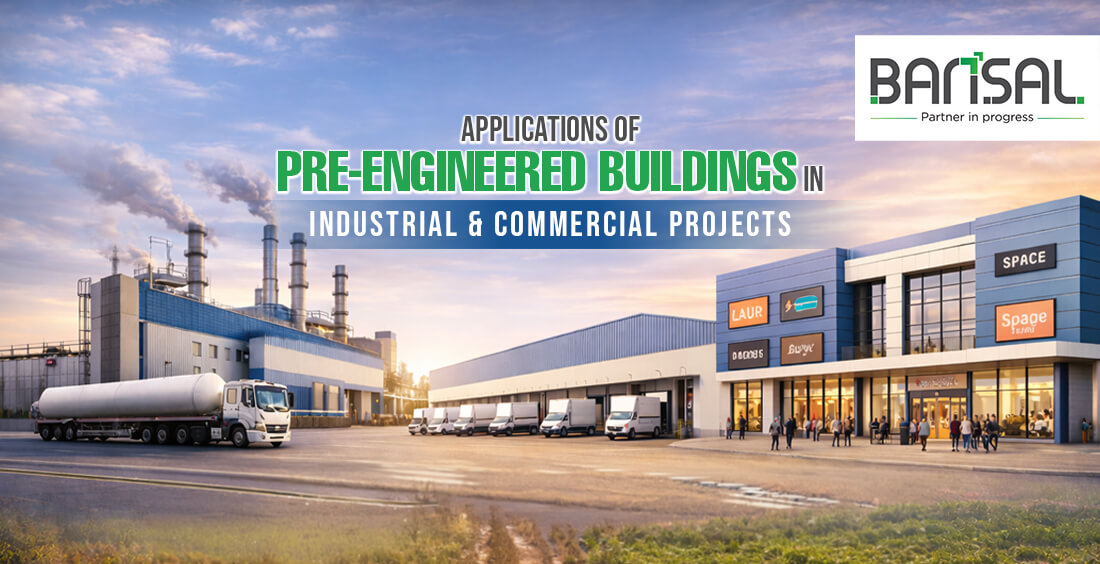
Applications of Pre-Engineered Buildings in Industrial & Commercial Projects
Posted on: Feb 23, 2026
Summary: What decision-makers should know
Pre-engineered buildings (PEBs) offer faster project execution, predictable costs, and long-term asset value. This blog explains the most important peb applications across industrial and commercial sectors. It focuses on use cases that matter to business owners, project heads, and investors, including factories, warehouses, logistics hubs, offices, and retail spaces. You’ll also understand why steel structure buildings are becoming the preferred choice for scalable and capital-efficient construction.
Why Pre-Engineered Buildings Make Business Sense
Pre-engineered buildings are factory-designed steel structures that are manufactured off-site and assembled at the project location.
This approach reduces construction time, lowers cost overruns, and improves build quality.
For decision-makers, this means:
- Faster go-to-market
- Better capital utilization
- Lower lifecycle costs
This is why peb applications are growing rapidly across industrial and commercial real estate.
Key Business Advantages of Peb Construction
PEBs are not chosen only for speed. They deliver long-term value.
Core advantages include:
- 30–50% faster construction timelines
- Lower foundation and material costs
- High structural strength with less steel
- Predictable project scheduling
- Easy future expansion
For investors, this translates into faster revenue generation and reduced project risk.
Peb Applications in Industrial Projects
Manufacturing Plants and Production Facilities
Manufacturing units require uninterrupted floor space and load-bearing capacity.
Industrial peb buildings are ideal because they:
- Provide large clear spans
- Support heavy machinery and cranes
- Allow flexible production layouts
These buildings are commonly used in:
- Engineering units
- FMCG manufacturing
- Automotive and component plants
Steel structures also perform better in seismic and high-wind zones.
Warehouse and Logistics Infrastructure
A warehouse peb structure is one of the most common and profitable PEB applications.
PEBs are widely used for:
- Distribution centers
- Fulfilment hubs
- Cold storage facilities
- Raw material warehouses
Why businesses prefer PEB warehouses:
- High roof height for vertical storage
- Faster construction for quicker operations
- Easy integration with automation systems
For logistics-driven businesses, speed equals revenue.
Power, Utility, and Infrastructure Projects
PEBs are extensively used in:
- Power plants
- Substations
- Utility sheds
- Industrial service buildings
Steel structures provide durability, safety, and long service life with minimal maintenance.
Peb Applications in Commercial Projects
Corporate Offices and IT Parks
Modern businesses demand flexibility. Commercial peb buildings allow:
- Open office layouts
- Modular interiors
- Faster occupancy
They are ideal for:
- Corporate offices
- IT parks
- Business centers
- Training facilities
Steel buildings also support modern architectural finishes without compromising structure.
Retail Spaces and Showrooms
Retail projects are time-sensitive.
PEBs help brands:
- Launch faster
- Reduce construction delays
- Achieve large column-free display areas
This makes them suitable for:
- Automobile showrooms
- Retail outlets
- Shopping complexes
Educational and Institutional Buildings
Institutions often operate with budget and time constraints.
PEBs are used for:
- Schools and colleges
- Skill development centers
- Auditoriums and labs
They offer safety, scalability, and cost efficiency.
Why Steel Structure Buildings Attract Investors
A steel structure building is a long-term asset.
From an investment perspective:
- Steel has high durability
- Maintenance costs are lower
- Asset life is predictable
Steel is also recyclable, which supports ESG and sustainability goals.
This makes PEB projects attractive for industrial parks, logistics investors, and commercial developers.
Manufacturing Quality Matters in PEB Projects
The performance of a PEB depends on design precision and fabrication quality.
Advanced PEB systems offer:
- Optimized steel usage
- Corrosion-resistant coatings
- Engineered connections for safety
End-to-end manufacturing ensures consistent quality and faster execution. This reduces dependency on on-site labor and minimizes project risk.
When Should Businesses Choose PEB Construction?
PEBs are ideal when:
- Time-to-market is critical
- Budget control is important
- Expansion is planned in future
- Large open spaces are required
These factors make peb applications suitable for both greenfield and brownfield projects.
Why Choose Bansal Poles?
Bansal Poles delivers precision-engineered pre-engineered building solutions designed for strength, speed, and scalability. With advanced manufacturing capabilities, high-grade steel, and strict quality control, the company ensures durable and cost-efficient steel structure buildings for industrial and commercial projects. From design to installation, Bansal Poles provides end-to-end support, helping businesses reduce project risk and achieve faster completion timelines.
Conclusion: A Smarter Way to Build and Scale
Pre-engineered buildings are no longer an alternative. They are a strategic choice. For businesses and investors, PEBs offer:
- Faster returns
- Lower risk
- Scalable infrastructure
From industrial plants to commercial hubs, PEBs deliver speed, strength, and financial efficiency.
Choosing the right steel structure solution today can define operational success tomorrow.
Frequently Asked Questions
Pre-engineered buildings are used for factories, warehouses, logistics centers, offices, retail spaces, and institutional buildings.
Peb applications are growing due to faster construction, cost savings, and flexibility in industrial layouts.
Yes. Warehouse peb structures reduce construction time and offer lower lifecycle costs.
Yes. Commercial peb buildings support modern architecture and flexible interiors.
A steel structure building can last 30–50 years or more with proper maintenance.
Yes. PEBs offer faster project completion and quicker revenue generation.
Yes. PEBs allow easy horizontal and vertical expansion.
Yes. Steel is recyclable and PEB construction reduces material waste.

Comments (0)
Post Your Comment