
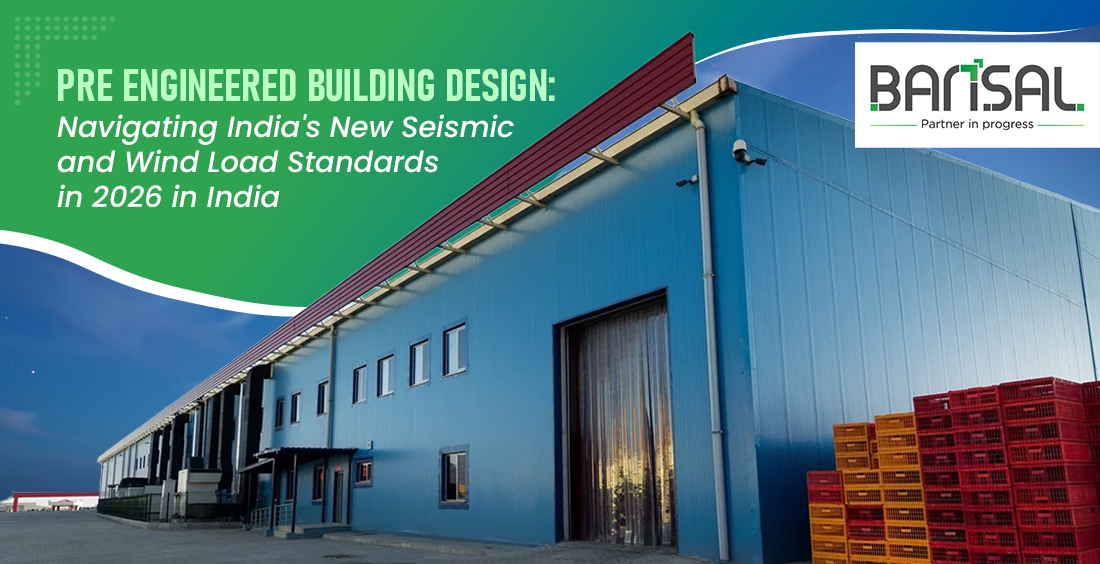
Pre Engineered Building Design: Navigating India's New Seismic and Wind Load Standards in 2026
Posted on: Apr 17, 2026
The Indian construction landscape is undergoing a radical transformation. As we move through 2026, the demand for resilient, sustainable, and rapid infrastructure has made Pre-Engineered Building Design the cornerstone of industrial development. However, with increasing climatic volatility and updated geological risk assessments, the Bureau of Indian Standards (BIS) has introduced more stringent codes. Designing a warehouse or factory today is no longer just about space optimization; it is about surviving the intensifying forces of nature.
The Evolution of PEB Design in India’s Changing Climatic Landscape
Historically, PEB structures were favored primarily for their cost-effectiveness and speed. However, as India experiences more frequent high-intensity cyclones and seismic tremors in previously "stable" regions, the focus has shifted toward structural resilience. Traditional designs often relied on older iterations of the Indian Standards (IS) codes, which provided broad generalizations for vast regions.
Today, the evolution of PEB Design involves a more granular approach. We are seeing a move away from "one-size-fits-all" templates toward site-specific engineering. This evolution is driven by the necessity to protect high-value industrial assets and ensure the safety of the workforce in an era where "unprecedented" weather events have become the new normal.
Why Precision in Pre-Engineered Building Design is Non-Negotiable Today
Precision is the difference between a structure that lasts fifty years and one that fails during its first major storm. In the realm of pre-engineered building design, precision begins at the software level. Engineers now utilize advanced Finite Element Analysis (FEA) to simulate how a building will react to localized stresses.
When keywords like "load-bearing capacity" and "deflection limits" are discussed, they are grounded in the updated IS 800:2007 (General Construction in Steel) and its subsequent 2026 amendments. Precision ensures that every bolt, rafter, and purlin is optimized - not just to save material costs, but to ensure that the structural integrity remains uncompromised under the maximum probable load.
Understanding the Updated Seismic Zone Mapping for Industrial Projects
Earthquake-resistant design is no longer an optional "add-on" for projects in Northern or North-Eastern India; it is a mandatory integration for every industrial blueprint across the subcontinent. The 2026 seismic updates have reclassified several Tier-2 cities into higher-risk zones, necessitating a total rethink of ductile detailing in steel structures.
Mandatory Earthquake-Resistant Phases
The design phase now mandates the following:
- Site-Specific Response Spectra: Moving beyond general zone factors to analyze the specific soil-structure interaction.
- Ductility Requirements: Ensuring that the PEB frame can dissipate energy during a seismic event without sudden collapse.
- Importance Factors: Higher factors are now applied to industrial buildings housing hazardous materials or critical infrastructure, as per the latest revisions to IS 1893 (Part 4).
Solving for High-Velocity Wind Loads in Coastal and Hilly Terrains
Wind pressure is often the primary cause of structural failure in large-span PEBs. In coastal regions like Odisha, Gujarat, and Andhra Pradesh, or hilly terrains like Sikkim, wind speeds can exceed 55 m/s (nearly 200 km/h).
Modern design software now accounts for:
- Topography Factors: Adjusting for how hills or cliffs can accelerate wind speeds.
- Cyclonic Importance Factors: A newer inclusion in the 2026 standards to provide an extra margin of safety for coastal infrastructure.
- Internal Pressure Coefficients: Calculating how wind behaves if a door or window is breached, preventing the "pop-off" effect on roof panels.
By utilizing IS 875 (Part 3), designers can calculate the specific wind pressure at various heights of the building, ensuring the cladding and secondary members (purlins/girts) are robust enough to withstand suction and pressure.
How a Leading PEB Building Company Implements New Standards
Compliance is a journey from the drafting board to the construction site. A professional peb building company acts as the bridge between theoretical safety and physical reality. It isn't enough to have a compliant design; the manufacturing process must mirror those specifications exactly.
From Blueprint to Site Compliance
A leading peb building company ensures:
- Material Traceability: Using high-tensile steel that meets updated IS certifications.
- On-site Supervision: Verifying that the anchor bolts - the critical link between the steel and the foundation - are installed with the precision required to resist uplift during high winds.
Key Benefits of Advanced PEB Design for Scalable Infrastructure
Investing in advanced PEB Design offers more than just safety; it provides a platform for business growth. Scalability is a core advantage of pre-engineered systems.
- Faster Turnaround: Despite the more complex calculations required for 2026 standards, modern automation allows for faster fabrication than traditional steel buildings.
- Cost-Efficiency: Advanced design reduces "over-engineering." By putting the strength exactly where the codes require it and removing excess weight elsewhere, owners save on raw material costs.
Why Choose Bansal Poles for Your PEB Construction Needs?
In an era where structural failure is not an option, Bansal Poles stands as a Tier-1 manufacturer with over 40 years of engineering excellence. We don’t just build structures; we provide "2026-ready" infrastructure that integrates the latest safety mandates into every column and rafter. Explore our full range of Pre-Engineered Building solutions designed for modern Indian standards.
The Future of Industrial Safety: Beyond the 2026 Standards
As we look past 2026, the integration of IoT sensors within PEB frames is becoming the next frontier. These sensors can monitor real-time stress and strain during wind or seismic events, providing data that will inform the next generation of Indian Standards. The goal is "Living Infrastructure" - buildings that not only meet codes but actively report on their own health.
Conclusion: Partnering for Compliance and Resilience
The complexity of modern Indian Standards means that the margin for error has vanished. Navigating the 2026 seismic and wind load updates requires more than just software; it requires a partner with deep technical expertise and a commitment to safety.
Choosing a partner who understands the intricacies of the latest IS codes ensures that your investment is not just a building, but a resilient asset capable of weathering any storm. Prioritize compliance today to build the industrial landmarks of tomorrow.
Frequently Asked Questions
It’s no longer about general guesses. Modern
Pre Engineered Building Design uses what we call site-specific response
spectra. Essentially, we look at exactly how the soil on your specific plot
interacts with a tremor rather than just looking at a broad zone map. The steel
frames are then built with "ductile detailing," which basically means
the building is designed to flex and absorb energy during an earthquake instead
of snapping under the pressure.
Compliance isn't just a certificate; it’s in
the math. A reliable peb building company uses software to crunch numbers based
on IS 875 (Part 3). They have to account for "topography
factors"—basically how nearby hills or coastlines can actually speed up
the wind before it hits your walls. If they aren't calculating for that
localized "suction" and "uplift," the building isn't truly
compliant.
Precision is the only thing that keeps a
structure from failing during a once-in-a-decade storm. In PEB Design, we use
Finite Element Analysis (FEA) to digitally "stress test" every single
part of the building before it's even manufactured. This ensures that every
bolt and rafter meets the exact load-bearing capacity required by the updated
IS 800:2007. It’s not about saving a few bucks on steel; it’s about making sure
the "backbone" of the building doesn't give way.
It’s always easier to build it right from the
start, but yes, it’s possible. A seasoned peb building company can assess an
older structure to see where it’s lacking. Often, this involves adding extra
bracing or reinforcing the connection points so the building can handle the
updated seismic and wind load requirements without needing a full teardown.
Actually, it can be the opposite. When you
use precision software to figure out exactly where the building needs strength,
you stop "over-engineering". You put the steel exactly where the 2026
codes require it and strip away the wasted weight elsewhere. This keeps the
structure 100% safe while actually helping to control material costs.
Think of anchor bolts as the
"roots" of your building. They are the only thing holding that
massive steel frame to the concrete foundation. In high-wind areas, a leading
peb building company pays obsessive attention to these. If they aren't placed
with absolute precision, the "uplift" from a storm can literally pull
the building off its base.
Coastal projects get a lot more scrutiny now.
The 2026 updates include "Cyclonic Importance Factors," which means
the PEB Design has to be much tougher. We have to calculate for "internal
pressure"—essentially making sure that if a door or window blows in during
a cyclone, the resulting air pressure inside doesn't cause the roof panels to
pop off like a lid.
Comments (0)
Post Your Comment