
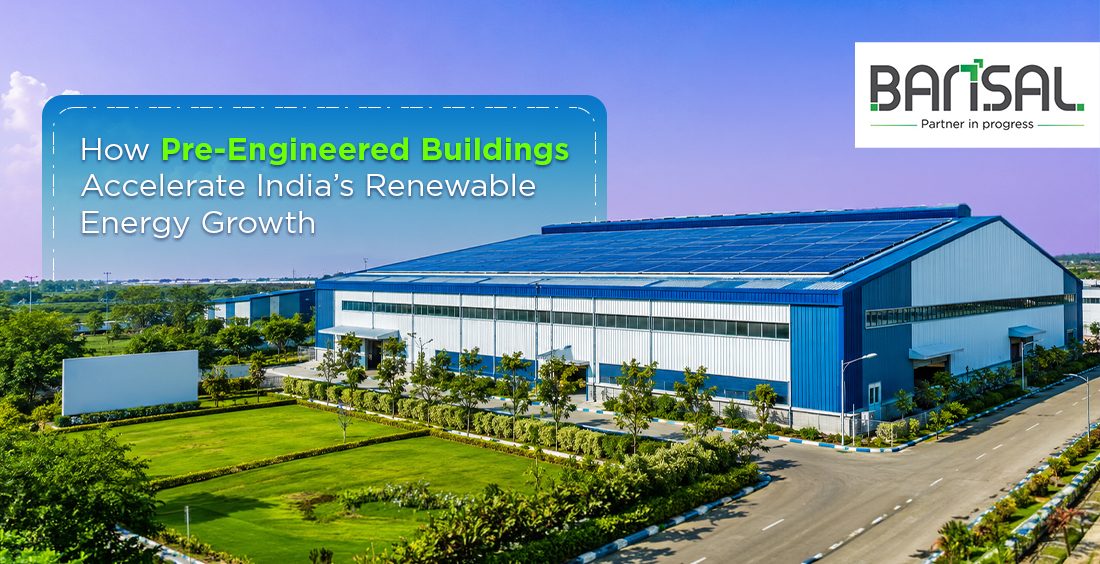
How Pre-Engineered Buildings Accelerate India’s Renewable Energy Growth
Posted on: Sep 16, 2026
India is rapidly expanding its renewable energy capacity through solar parks, wind farms, battery storage projects, and clean energy manufacturing facilities. However, generating renewable power is only one part of the development process. These projects also require control rooms, equipment shelters, warehouses, workshops, and production buildings.
Such infrastructure must be constructed quickly, safely, and efficiently. This is where a pre-engineered building can offer a practical solution. Designed according to specific project requirements, PEB structures support faster construction, flexible layouts, and dependable performance across several renewable energy applications.
The Role of Pre-Engineered Building Technology in Fast-Tracking Green Projects
Traditional construction often involves extensive on-site fabrication, welding, cutting, and structural assembly. These activities can be affected by weather, labour availability, transportation issues, and site limitations.
A pre-engineered building follows a more coordinated approach. Major steel components are designed and fabricated at a manufacturing facility before being transported to the project site. Components such as columns, rafters, purlins, and other structural members are manufactured according to approved engineering drawings.
Once the foundations are ready, the components can be assembled using planned connections. This method offers several advantages:
- Faster construction: Much of the structural work is completed before delivery to the site.
- Reduced site delays: Foundation work and steel fabrication can progress simultaneously with proper coordination.
- Better material control: Computer-aided design and controlled fabrication can help reduce material wastage.
- Flexible layouts: Building dimensions and internal arrangements can be adapted to project needs.
- Improved planning: Detailed drawings and standardised components make installation more organised.
The actual construction period depends on project size, design complexity, site conditions, approvals, and material availability. Nevertheless, PEB technology can help renewable energy developers reduce avoidable delays and bring supporting infrastructure into operation sooner.
Key Renewable Applications Powered by PEB Infrastructure
Renewable energy projects require different types of support buildings. A pre-engineered building can be customised for several important applications.
1. Solar power plant control rooms
Solar parks need control rooms to monitor energy generation, manage electrical systems, and coordinate daily operations. PEB structures can accommodate control panels, monitoring equipment, cable routes, HVAC systems, and operator areas.
The design should consider equipment clearances, temperature control, electrical safety, maintenance access, and ventilation requirements.
2. Inverter and electrical equipment stations
Solar inverters convert the direct current produced by photovoltaic panels into alternating current. Inverters, transformers, switchgear, and related systems may require dedicated shelters or enclosed structures.
A PEB solution can provide protection from weather and support organised equipment placement. Proper attention must be given to heat dissipation, ventilation, fire safety, equipment loads, and access for maintenance teams.
3. Wind energy support facilities
Wind farms are often located in remote areas where transporting construction materials and managing extensive site work can be difficult. PEB structures can be used for maintenance workshops, spare-parts storage, administrative offices, and equipment shelters.
These buildings can provide functional working space while allowing future extensions or modifications as the wind project expands.
4. Renewable energy manufacturing plants
India’s clean energy transition is increasing the demand for manufacturing facilities for solar modules, batteries, mounting systems, and electrical equipment. These plants require space for machinery, production lines, raw materials, finished goods, and internal movement.
A pre-engineered building can offer large-span spaces and adaptable layouts. Depending on the application, the design may also need to accommodate overhead cranes, suspended services, machinery foundations, special flooring, and heavy equipment.
5. Battery energy storage facilities
Battery energy storage systems help manage fluctuations in renewable power generation and support grid stability. Their infrastructure may include equipment rooms, control centres, service buildings, and maintenance areas.
PEB structures may be suitable for selected support facilities. However, battery projects require detailed planning for thermal management, ventilation, fire protection, electrical safety, and emergency access. Building design must be coordinated with the battery system supplier and relevant safety professionals.
Why Partnering with a Top PEB Manufacturer in India Ensures Long-Term ROI
Selecting the right peb manufacturer in India is essential for the safety, performance, and long-term value of a renewable energy facility. A PEB is not simply a collection of prefabricated steel parts. Its performance depends on engineering quality, material selection, fabrication accuracy, installation, and maintenance.
An experienced manufacturer can develop a design suited to the project’s location and intended use. Important factors include wind loads, seismic conditions, soil characteristics, roof loads, corrosion exposure, drainage, and future expansion requirements.
Renewable energy facilities may also need specialised provisions for electrical equipment, ventilation, cable openings, access routes, and maintenance operations. These requirements should be considered before fabrication begins.
PEB construction can contribute to long-term return on investment through efficient material usage, planned fabrication, reduced site work, and potentially lower construction overheads. Faster completion may also help project owners start operations earlier.
Bansal Poles Pvt Ltd offers pre-engineered building solutions for industrial and infrastructure applications. To explore suitable options, visit the pre-engineered building solutions page.
Sustainability Advantages: How a Pre-Engineered Building Supports Net-Zero Goals
A pre-engineered building can support sustainable construction through efficient steel fabrication, reduced material wastage, and recyclable components. Steel can also be reused or recycled at the end of the building’s life.
PEB structures may include insulation, natural ventilation, daylighting, and energy-efficient services to reduce lighting and cooling needs. Their flexible design also allows future expansion or modification, reducing the need for complete reconstruction.
However, PEB construction alone does not make a project net-zero. Overall sustainability depends on material production, transportation, energy use, maintenance, and end-of-life management.
Conclusion
India’s renewable energy ambitions require infrastructure that is quick to construct, reliable in operation, and flexible enough to meet future demands. A pre-engineered building can support solar power plants, wind energy facilities, inverter stations, battery storage infrastructure, and green manufacturing units.
Through off-site fabrication, engineered steel components, and adaptable layouts, PEB technology can help developers manage construction timelines and long-term operational needs. Partnering with a reliable peb manufacturer in India is crucial for achieving these benefits.
For project-specific requirements, connect with Bansal Poles and explore its pre-engineered building solutions.
Frequently Asked Questions
A pre-engineered building is a steel structure whose components are designed and fabricated according to project requirements before being assembled at the site. It can be used for solar control rooms, inverter stations, workshops, warehouses, and renewable energy manufacturing facilities.
A PEB uses off-site fabrication, allowing major structural components to be manufactured before delivery. This reduces on-site fabrication and can help coordinate foundation work and building assembly more efficiently.
PEB structures can be suitable for solar control rooms, inverter stations, wind farm maintenance buildings, renewable energy factories, warehouses, and selected battery storage support facilities. Each application requires a design suited to its technical and safety needs.
Consider the manufacturer’s engineering expertise, fabrication capabilities, quality-control processes, project experience, and installation support. Check whether it can account for site conditions, equipment loads, corrosion protection, and future expansion.
Yes. Efficient fabrication, material optimisation, recyclable steel components, insulation, and energy-efficient services can support sustainable construction. The overall environmental performance still depends on the building’s complete lifecycle, including materials, energy use, and maintenance.

Comments (0)
Post Your Comment