
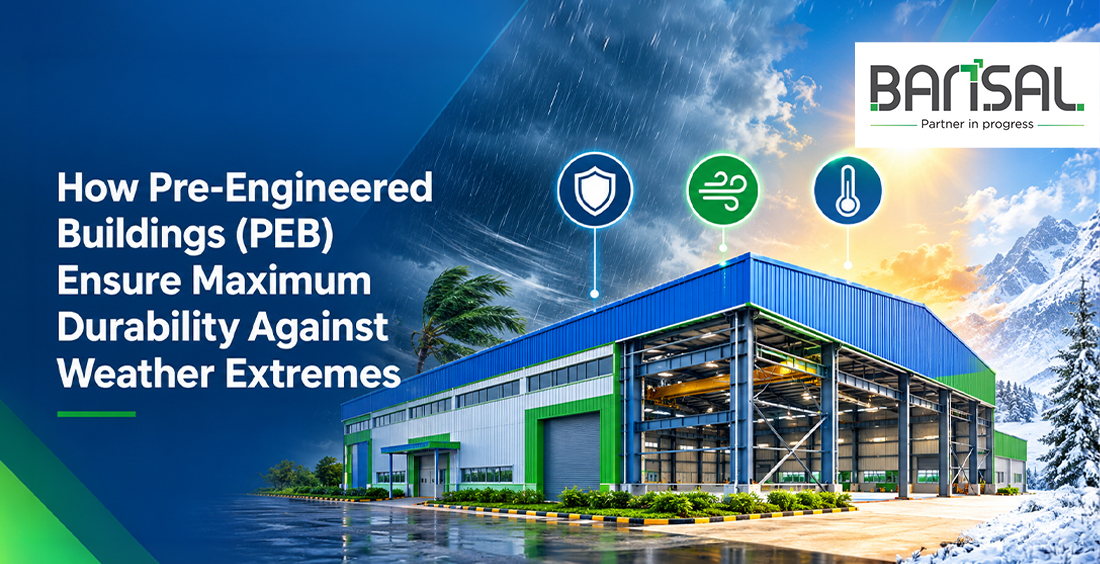
How Pre-Engineered Buildings (PEB) Ensure Maximum Durability Against Weather Extremes
Posted on: Oct 24, 2026
Introduction: Modern Industrial Infrastructure vs. Climate Volatility
Weather can have a major impact on the life of an industrial building. Warehouses, factories and logistics facilities may face heavy monsoons, strong winds, high temperatures and, in some regions, seismic activity.
A properly designed pre-engineered building offers a practical way to address these challenges. PEB structures are designed according to project-specific requirements, with steel components fabricated under controlled conditions and assembled at the site.
This approach allows the structure to be designed around local wind, rainfall and other environmental conditions. However, durability depends on more than the steel frame. Structural design, connections, roofing, drainage, corrosion protection and installation quality all contribute to long-term performance.
The Climate Threats to Industrial & Commercial Structures
Industrial buildings are exposed to several weather-related stresses during their service life.
- High-velocity cyclonic winds and uplift: Strong winds exert pressure on walls and can create significant uplift on roofs. Properly designed frames, bracing and connections are therefore essential.
- Monsoonal deluges and water ingress: Heavy rainfall can overwhelm poorly designed drainage systems. Insufficient roof slopes, blocked outlets and inadequate gutters can result in water accumulation and leakage.
- Thermal contraction and solar radiance: Metal roofs and structural components expand when heated and contract as temperatures fall. Repeated cycles can put stress on joints, fasteners and roofing systems.
- Seismic vulnerability: Buildings in earthquake-prone areas must account for lateral movement and ground forces. Properly designed steel structures can provide ductility and help dissipate seismic energy.
The Engineering Behind PEB Weather Resilience
Several engineering features contribute to the weather resilience of a PEB system.
- Tapered I-sections and built-up frames: Primary frames can be fabricated with varying dimensions according to the loads acting on different parts of the structure. This helps optimise material usage while maintaining the required strength.
- High strength-to-weight ratio and ductility: Structural steel provides high strength relative to its weight. Its ductile nature allows appropriately designed members and connections to deform under extreme loading rather than failing suddenly.
- Standing seam roofing technology: Where specified, standing seam roofing reduces exposed roof penetrations. Properly installed seams can provide better protection against rainwater ingress and reduce maintenance requirements.
- Protective coatings and anti-corrosion systems: Steel requires suitable protection, particularly in coastal and humid environments. Galvanized coatings, metallic coatings and protective paint systems can help limit corrosion.
- Engineered drainage and gutter capacities: Roof slopes, gutters and downpipes should be designed to handle expected rainfall. Efficient drainage prevents water accumulation and helps protect the building from leakage-related damage.
Comparative Analysis: PEB vs. Conventional Steel / RCC Construction
|
Parameter |
Pre-Engineered
Building (PEB) |
Conventional
Concrete / Structural Steel |
|
Wind &
Seismic Resistance |
Designed for
project-specific environmental and structural loads |
Depends on
the structural system, design and applicable loads |
|
Water
Management |
Roofing,
gutters and drainage can be engineered as an integrated system |
Performance
depends on the specific roof and drainage design |
|
Corrosion
Protection |
Factory-applied
coatings can provide controlled and consistent application |
Protection
quality depends on the specified system and application conditions |
|
Construction
Speed |
Factory
fabrication and site assembly can reduce on-site construction time |
Conventional
methods may involve more site-based fabrication or construction work |
Selecting the Right Partner: What to Look for in a PEB Manufacturer in India
Selecting an experienced peb manufacturer in India is an important part of achieving long-term structural performance.
A reliable manufacturer should have strong engineering capabilities and follow applicable Indian Standards, including IS 800 for steel structures, IS 875 for design loads and IS 1893 for earthquake-resistant design, wherever applicable.
Manufacturing quality is equally important. CNC cutting, controlled welding, accurate profiling and systematic quality checks can help maintain dimensional accuracy. Material certificates, weld inspections and coating checks can provide additional assurance.
Bansal Poles provides engineered solutions for industrial and commercial applications, covering structural design, fabrication and project execution. Businesses can explore pre-engineered building solutions by Bansal Poles.
Real-World Applications Built for Heavy Weather Exposure
PEB systems are suitable for several applications where durability and efficient space utilisation are important.
- Logistics and warehousing hubs can use clear-span designs to create large usable floor areas with fewer internal columns. Structures can also be designed according to local environmental loads.
- Manufacturing plants and heavy workshops can be engineered around operational requirements such as equipment placement and crane loads while maintaining structural stability.
- Coastal and marine-adjacent facilities require additional attention to corrosion protection. Appropriate coatings, material selection and regular inspections can help extend the service life of steel components in high-moisture environments.
Conclusion
Frequently Asked Questions
A pre-engineered building is designed for site-specific wind loads, including pressure and roof uplift. Frames, bracing, connections and anchoring work together to transfer these forces safely to the foundation.
Yes. Suitable metallic coatings, galvanized components and protective paint systems can help protect steel from corrosion. The specification should be based on the site's humidity, salt exposure and operating conditions.
Steel offers a high strength-to-weight ratio and ductile behaviour when properly designed. Its relatively low structural weight can also help reduce seismic inertial forces. The complete structure must still comply with applicable seismic design requirements.
The roof slope, panels, gutters, valleys and downpipes can be designed according to the project's rainfall and drainage requirements. Regular cleaning and maintenance are also important for preventing blockages and water accumulation.
Check the manufacturer's engineering expertise, fabrication capabilities, quality-control processes, compliance with relevant standards and experience with similar industrial projects. Proper corrosion protection and reliable site installation are also important considerations.


Comments (0)
Post Your Comment