
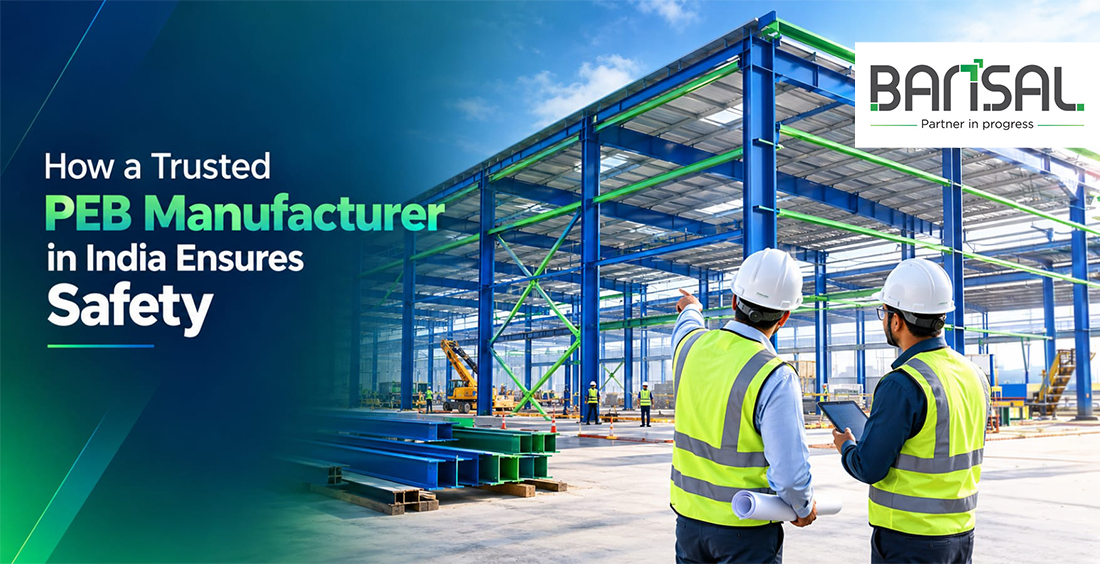
How a Trusted PEB Manufacturer in India Ensures Safety
Posted on: Oct 31, 2026
When planning a factory, warehouse, or industrial shed, safety should never be an afterthought. A building must withstand expected loads, handle local weather conditions, and provide a stable environment for daily operations.
This is why choosing a trusted PEB manufacturer in India matters. Pre-engineered buildings (PEBs) use engineered steel components that are manufactured and assembled according to project requirements. Their safety depends on several factors, including structural design, material quality, fabrication, and installation.
Let's look at how these elements contribute to a safe and reliable building.
Safety Begins with Accurate Structural Design
Every building has different requirements. A warehouse with a large roof span may need a different structural arrangement from a factory housing heavy machinery.
A suitable pre-engineered building design starts with understanding the building's purpose, location, dimensions, and expected usage.
Engineers calculate the loads the structure must withstand, including its own weight, roof loads, and wind pressure. Depending on the project, seismic forces, suspended equipment, and overhead crane loads may also need consideration.
The design should follow applicable structural standards, including relevant Indian Standards. Proper calculations help engineers determine suitable steel members, connections, and bracing arrangements.
This ensures that the building's structural components work together to maintain stability under the conditions considered during design.
Quality Steel Makes a Difference
Steel quality directly influences the performance of a PEB structure. Using materials that do not meet the specified requirements can compromise structural integrity.
A reliable PEB manufacturer in India selects steel grades and member dimensions according to engineering specifications. Material certificates and quality checks help verify that the steel meets the required standards.
However, safety is not determined by steel grade alone. Correct member sizing, connection details, fabrication quality, and proper installation are equally important.
Bansal Poles Limited offers pre-engineered building solutions for industrial and commercial applications.
Explore the pre-engineered building solutions offered by Bansal Poles to learn more about its offerings.
Factory Fabrication Helps Maintain Quality
PEB components are manufactured in a factory before being transported to the construction site. This allows manufacturers to follow defined production procedures and conduct quality checks at different stages.
Processes such as cutting, drilling, welding, and assembly preparation must follow approved drawings and specifications. Dimensional inspections and appropriate welding checks help identify defects before components are dispatched.
Accurate fabrication also makes site assembly easier because components are manufactured to match the approved design.
However, factory production alone does not guarantee safety. Consistent quality control, skilled personnel, and compliance with specifications remain essential.
Protection Against Wind, Rain, and Corrosion
Buildings across India face different weather conditions, from heavy monsoon rainfall to strong winds and high temperatures. These conditions must be considered during planning and design.
A dependable PEB manufacturer in India considers the building's location and exposure when developing the structural system and selecting suitable protective measures.
Engineers assess wind loads, while roof sheets, cladding, fasteners, and connections must be appropriate for the specified design conditions.
Proper roof slopes, gutters, and drainage arrangements help prevent water accumulation and reduce leakage risks. Protective coatings or galvanizing, where appropriate, can help limit corrosion.
Regular inspections and maintenance are also necessary to preserve the building's condition over time.
Proper Connections and Installation Ensure Stability
Even a well-designed structure can face problems if it is assembled incorrectly.
PEB installation requires accurate positioning of columns, anchor bolts, structural frames, and bracing. Foundation levels and anchor-bolt locations must match the approved drawings.
Bolted connections should be completed according to specified requirements, and the structure must remain adequately stabilised during erection.
Any site modification affecting structural members or connections should receive approval from the responsible engineer.
Following appropriate erection procedures and workplace safety practices helps reduce construction risks and ensures that the installed structure performs as intended.
Compliance and Quality Control Build Confidence
Before selecting a manufacturer, businesses should understand the design standards, material specifications, inspection procedures, and technical documentation available for their project.
Relevant Indian Standards may include IS 800 for steel structures and applicable parts of IS 875 for design loads. The responsible engineers should confirm which standards and editions apply.
It is also important to clarify responsibilities for structural calculations, foundation design, fabrication, installation, and final inspections.
A trusted PEB manufacturer in India should be able to explain its quality-control processes and provide relevant project documentation.
Conclusion
Building safety depends on more than strong steel. Accurate engineering, suitable materials, controlled fabrication, weather protection, and proper installation all contribute to a reliable pre-engineered building.
Choosing a trusted PEB manufacturer in India helps businesses evaluate these factors before construction begins. With appropriate planning, a well-executed pre-engineered building design can provide a practical solution for factories, warehouses, and industrial facilities.
Frequently Asked Questions
Through structural calculations, material checks, fabrication inspections, and proper installation procedures. Foundation design and site execution must also meet project requirements.
It determines how the structure carries loads and helps engineers select suitable steel members, connections, and bracing for the building's intended use.
Depending on the project, relevant standards may include IS 800 for steel structures and IS 875 for design loads. Engineers should verify the applicable requirements.
Yes, when appropriately designed for the site's wind conditions, with suitable structural members, connections, cladding, and anchorage.
Evaluate engineering expertise, material specifications, quality-control procedures, project experience, and technical documentation before making a decision.


Comments (0)
Post Your Comment