
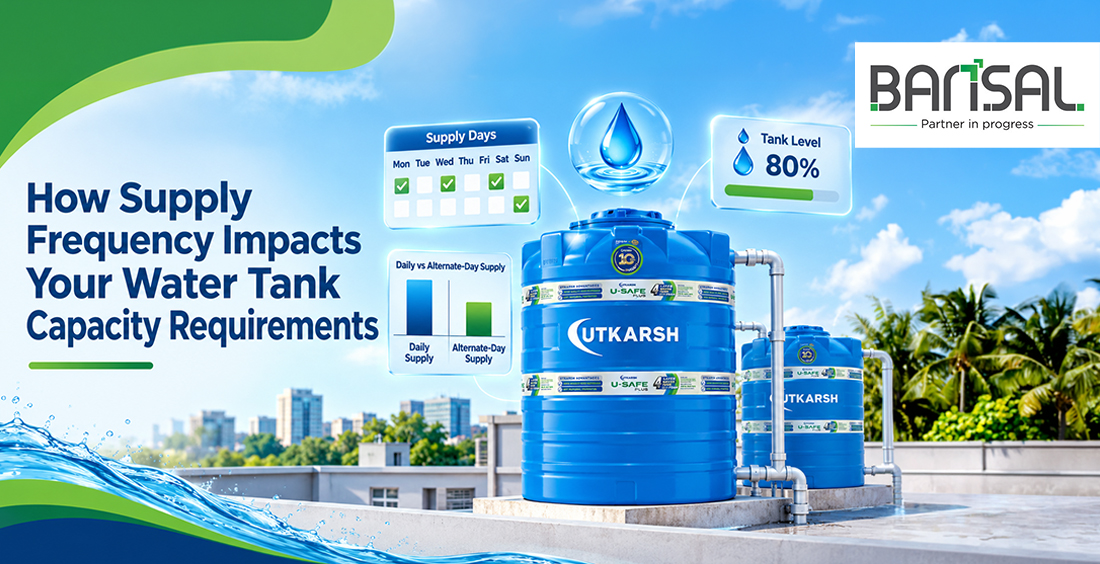
How Supply Frequency Impacts Your Water Tank Capacity Requirements
Posted on: Nov 17, 2026
Choosing the right water tank capacity is not just about the size of your family. It also depends on how frequently your household receives water from the municipal supply. While some areas have a daily water supply, others receive it on alternate days or follow irregular schedules.
These differences directly affect how much water you need to store at home. A tank that works well for a household with a regular supply may fall short when water is available only twice or thrice a week. Understanding your daily consumption and supply schedule helps determine the right household water storage capacity, ensuring sufficient water for everyday needs without unnecessary storage.
Why Municipal Supply Schedules Dictate Ideal Water Tank Capacity
Municipal water supply schedules play an important role in determining the ideal water tank capacity for a household. The more frequently water is supplied, the easier it is to manage daily consumption with a smaller storage reserve. However, households receiving water at longer intervals need additional capacity to avoid shortages.
For instance, a family receiving water every morning may only need to store enough for daily consumption, along with a small reserve. In contrast, a household receiving water once every two days must store enough to cover the entire gap between supply cycles.
A few factors influence your water tank size calculation:
- Family size: More occupants generally mean higher water consumption.
- Daily usage: Drinking, cooking, bathing, washing clothes, cleaning and toilet flushing contribute to total demand.
- Supply frequency: Daily, alternate-day or weekly supply schedules require different storage capacities.
- Supply duration: A short supply window may not provide enough water to refill the tank completely.
- Emergency requirements: Unexpected interruptions, maintenance or low water pressure can increase storage needs.
For homes with overhead water storage, it is also important to consider how quickly the tank can refill and whether the incoming supply is sufficient to meet household demand.
Therefore, the ideal capacity should be based on actual consumption and the time between supply cycles, rather than family size alone.
Calculating Storage Sizing for Daily, Alternate, and Irregular Supply Windows
A practical way to determine the right water tank capacity for home use is to calculate daily consumption and multiply it by the number of days between supply cycles.
Basic calculation:
Required Storage = Daily Water Consumption × Days Between Supplies + Safety Buffer
Consider a family of four with an estimated daily consumption of 400 litres. The requirement will change depending on the municipal supply schedule.
|
Supply Frequency |
Estimated Storage Requirement |
|
Daily supply |
400–500 litres |
|
Alternate-day
supply |
800–1,000 litres |
|
Supply every 3 days |
1,200–1,500 litres |
- Daily Supply: A 500-litre tank may be sufficient for a smaller household with controlled consumption and a reliable daily supply. However, a larger reserve can be useful during unexpected interruptions.
- Alternate-Day Supply: A 1000 litre water tank can be a practical option for a family of four, depending on daily usage and the amount of water received during each supply cycle.
- Irregular Supply: Households facing unpredictable supply schedules should consider a larger storage reserve. However, the capacity should be based on the longest likely gap between supplies rather than storing excessive water indefinitely.
Why Sizing Matters: Stagnation Risks and the Need for a Food Grade Water Tank
- Food-grade material: Helps prevent unwanted interaction between the tank material and stored water.
- UV protection: Helps protect the tank against prolonged exposure to sunlight.
- Anti-algae protection: A suitable inner layer helps reduce algae growth by limiting light penetration.
- Secure lid: Prevents dust, insects and other external contaminants from entering.
- Durable construction: Helps maintain structural strength during regular use.
Sizing Guide for Bansal Household Water Storage Solutions
- 3-layer water tanks: Available in 500, 750, 1,000, 1,500 and 2,000-litre capacities.
- 4-layer water tanks: Designed for additional protective layers.
- 4-layer foam tanks: An option for households looking for foam-insulated storage.
Choose the Right Tank Capacity for Uninterrupted Home Water Safety
Frequently Asked Questions
A 1,000-litre tank is a practical starting point for many families of four, particularly where supply is not available every day. Actual requirements depend on consumption and supply frequency.
Multiply your estimated daily water consumption by the number of days between supply cycles. Add a safety reserve to account for unexpected interruptions and variations in usage.
It can be sufficient for a family of four with moderate consumption and a reliable supply schedule. However, households receiving water every two or three days may need additional storage.
A food grade water tank is made from materials suitable for storing drinking water. It helps minimise the risk of contamination caused by unsuitable tank materials.
The best water tank for home use should offer suitable capacity, food-grade material, UV protection, anti-algae features and durable construction. Bansal Poles offers multi-layer household water tanks in capacities ranging from 500 to 2,000 litres.


Comments (0)
Post Your Comment