
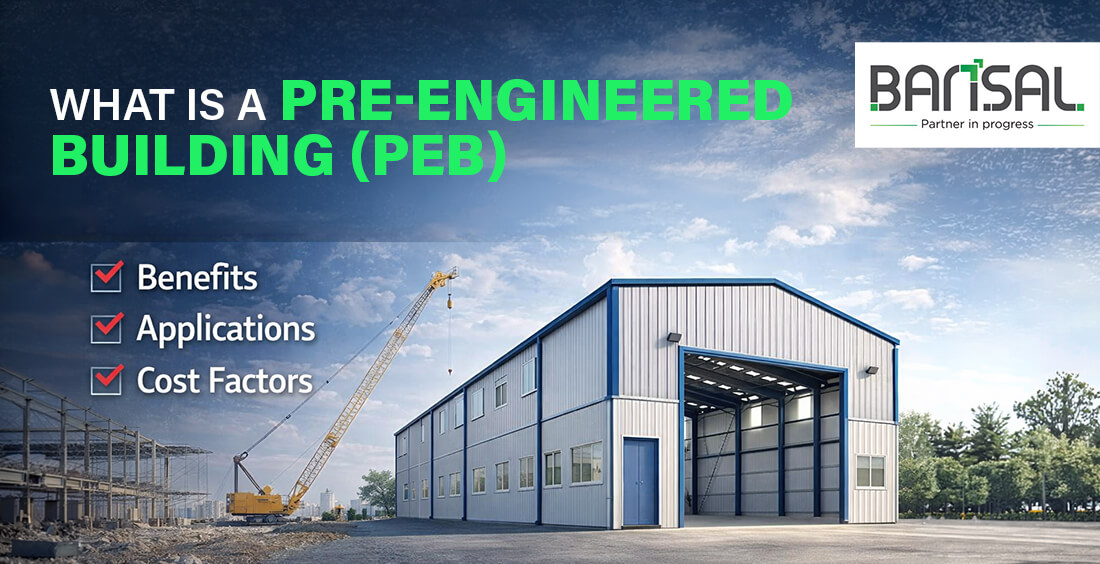
What Is a Pre-Engineered Building (PEB)? Benefits, Applications & Cost Factors
Posted on: Feb 23, 2026
Summary
A pre engineered building (PEB) is a modern construction method where building components are designed and manufactured in a factory and then assembled on site. As a result, construction becomes faster, more accurate, and cost-effective.
In this blog, you will learn what a pre engineered building is, how a peb structure works, and why industries prefer it today. In addition, the blog explains key peb building advantages, common applications, and the major factors that affect peb building cost. You will also understand why a pre engineered steel building offers better long-term value than traditional construction methods.
Built Smarter, Faster, and Stronger: Understanding Pre-Engineered Buildings
Construction today is very different from the past. Time is limited. Costs are increasing. Space planning matters more than ever. Because of these challenges, the pre engineered building concept has become popular. Instead of building everything on site, structures are designed and fabricated in advance. Then, they are assembled with precision.
As a result, construction is faster. Quality is better. Long-term savings are higher. Now, let us understand how pre engineered buildings work, where they are used, and what influences their cost.
What Is a Pre-Engineered Building?
A pre engineered building (PEB) is a steel structure that is designed and manufactured in a controlled factory environment. After fabrication, the components are transported and assembled at the site. Every component is planned in advance. Every measurement is accurate. Therefore, nothing is random. The design depends on usage, load requirements, climate conditions, and span length. Once approved, steel members are bolted together on site. This process significantly reduces construction time and improves quality.
Unlike conventional buildings, a pre engineered steel building does not rely on heavy on-site fabrication. Instead, everything is optimized before construction begins.
Understanding the PEB Structure
The strength of a pre engineered building comes from its design.
A typical peb structure includes:
- Primary framing such as columns and rafters
- Secondary framing including purlins, girts, and eave struts
- Roof and wall sheeting
- Bracing systems
- Anchor bolts and fasteners
Each component supports the other. Because of this, the structure remains stable under heavy loads. Moreover, modern PEB manufacturers use high-quality steel and advanced design software. This allows buildings to withstand wind pressure, seismic forces, and industrial loads.
Our pre-engineered buildings are engineered for durability and long service life, making them suitable for both industrial and commercial use.
How a Pre-Engineered Metal Building Is Made
The PEB process follows a clear sequence. First, the building is designed based on its purpose. Next, steel components are fabricated in a factory. Finally, these components are assembled on site. Because fabrication happens in a controlled environment, errors are minimal. In contrast, conventional construction depends heavily on site conditions.
As a result, this factory-controlled approach ensures consistent quality and faster project completion. This is also why PEBs are gaining popularity across India.
Peb Building Advantages That Matter
The peb building advantages go beyond quick construction.
- Faster Construction: PEBs can be completed in almost half the time of RCC buildings. Therefore, businesses can start operations sooner.
- Cost Efficiency: Optimized steel usage reduces wastage. In addition, lower labor requirements help control costs.
- Design Flexibility: PEBs offer large column-free spaces. Moreover, future expansion becomes easier.
- High Strength and Durability: Steel structures perform well in extreme weather. As a result, they offer better seismic resistance.
- Low Maintenance: Protective coatings reduce corrosion. Therefore, maintenance costs remain low.
- Sustainable Construction: PEBs use recyclable steel and produce less site waste. Because of this, they are environmentally friendly.
Overall, these benefits make pre engineered buildings a smart investment.
Applications of Pre-Engineered Buildings
PEBs are used across industries. Some common applications include:
- Industrial sheds and factories
- Warehouses and logistics centers
- Manufacturing plants
- Cold storage facilities
- Commercial buildings
- Aircraft hangars
- Sports complexes
- Workshops and service centers
Bansal Poles offers customized pre-engineered building solutions based on load, span, and operational needs. Therefore, PEBs can support both heavy machinery and large storage areas with ease.
Why Industries Prefer Pre-Engineered Steel Buildings
Industries need space, strength, and speed. A pre engineered steel building delivers all three.
Steel allows long spans without internal columns. As a result, workflow improves and equipment movement becomes easier.
In addition, PEBs allow future expansion without stopping operations. This flexibility is a major reason why industries prefer them.
Peb Building Cost: What Influences the Price?
The peb building cost depends on several factors.
- Building Size: Larger buildings usually have lower cost per square foot.
- Steel Grade and Quantity: Higher-grade steel improves durability but increases cost.
- Design Complexity: Mezzanine floors, cranes, and load requirements affect pricing.
- Roofing and Cladding: Insulated panels cost more than standard sheets but improve efficiency.
- Location and Logistics: Transportation distance and site access also matter.
However, when evaluated over the full lifecycle, PEBs are often more economical than RCC structures.
Long-Term Value of Pre-Engineered Buildings
PEBs are not only about initial savings. They also offer:
- Lower operating costs
- Reduced repair expenses
- Better energy efficiency
- Higher resale value
Over time, these benefits add up. Therefore, many logistics and manufacturing companies prefer pre engineered buildings.
Quality and Reliability in PEB Manufacturing
Not all PEBs offer the same quality. Performance depends on:
- Engineering expertise
- Steel quality
- Fabrication accuracy
- Coating standards
- Installation practices
Manufacturers like Bansal Poles focus on precision engineering and structural compliance. As a result, their buildings meet safety and performance standards.
Common Myths About Pre-Engineered Buildings
Myth 1: PEBs are temporary
Reality: Properly designed PEBs last for decades.
Myth 2: They lack aesthetics
Reality: Modern PEBs offer clean, professional designs with multiple finishes.
Myth 3: They are only for factories
Reality: PEBs are widely used for commercial and institutional buildings.
Understanding these facts helps make better construction decisions.
Why Choose Bansal Poles for Your Pre-Engineered Building?
Choosing the right partner is critical for any construction project. Bansal Poles offers expertly engineered pre-engineered building solutions designed for strength, durability, and long-term performance.
With advanced manufacturing capabilities and high-quality structural steel, the company ensures precision in every peb structure. In addition, each project is customized based on span, load requirements, and operational needs. As a result, clients receive reliable, cost-effective, and future-ready pre-engineered steel building solutions.
Bansal Poles focuses on quality, timely execution, and structural compliance, making it a trusted choice for industrial and commercial PEB projects.
The Future of PEB Construction
Speed, efficiency, and sustainability are no longer optional. They are essential.
The pre engineered building concept meets modern construction needs by reducing time and cost while improving performance. Therefore, adopting advanced PEB Construction methodologies offers a future-ready solution for growing businesses looking to scale rapidly and sustainably.
From Idea to Impact: Why PEBs Make Sense
Construction is a long-term investment. The right structure supports growth. A pre engineered steel building delivers strength, speed, and flexibility. Because of this, PEBs are not just buildings. They are strategic assets.
Mastering the PEB Construction Process for Industrial Efficiency
The PEB Construction Process is a highly streamlined, engineering-driven workflow designed to eliminate on-site bottlenecks and maximize structural precision. Unlike traditional building methods, the process begins with advanced structural 3D modeling and detailing, where every component is meticulously planned before fabrication. Once the engineered steel elements are manufactured under strict quality control standards in the factory, they are shipped directly to the site for rapid bolt-together assembly. This seamless end-to-end integration dramatically cuts down project timelines, minimizes material waste, and ensures that the entire PEB Construction Process delivers a future-ready, cost-effective structure for expanding businesses.
Frequently Asked Questions
Pre engineered buildings ( PEB ) are used for factories, warehouses, commercial spaces, and infrastructure projects.
Construction usually takes 30–50% less time compared to conventional buildings.
Yes. PEBs are designed to withstand heavy loads, wind, and seismic forces.
Costs vary based on size, design, steel grade, and location. However, PEBs are generally more cost-effective in the long run.
Yes. One of the biggest peb building advantages is easy future expansion.
Yes. They are designed considering local wind, rainfall, and seismic conditions.
PEBs use optimized steel designs and factory fabrication, while RCC relies on on-site construction and concrete.
Yes. They use recyclable steel and generate minimal construction waste.
A standard peb construction process is divided into three efficient phases: advanced structural engineering and 3D modeling, factory-controlled fabrication of steel components, and rapid on-site bolt-together assembly. Because detailing and manufacturing happen in a controlled factory environment before reaching the site, this process minimizes structural errors and slashes traditional project timelines by up to 50%.
A modern pre engineered metal building is intrinsically sustainable because structural steel is 100% recyclable without losing strength. Additionally, these structures are precision-cut in the factory to reduce job-site waste and can be seamlessly integrated with advanced sandwich insulation panels to drastically cut down heating and cooling energy expenditures.
Comments (0)
Post Your Comment