
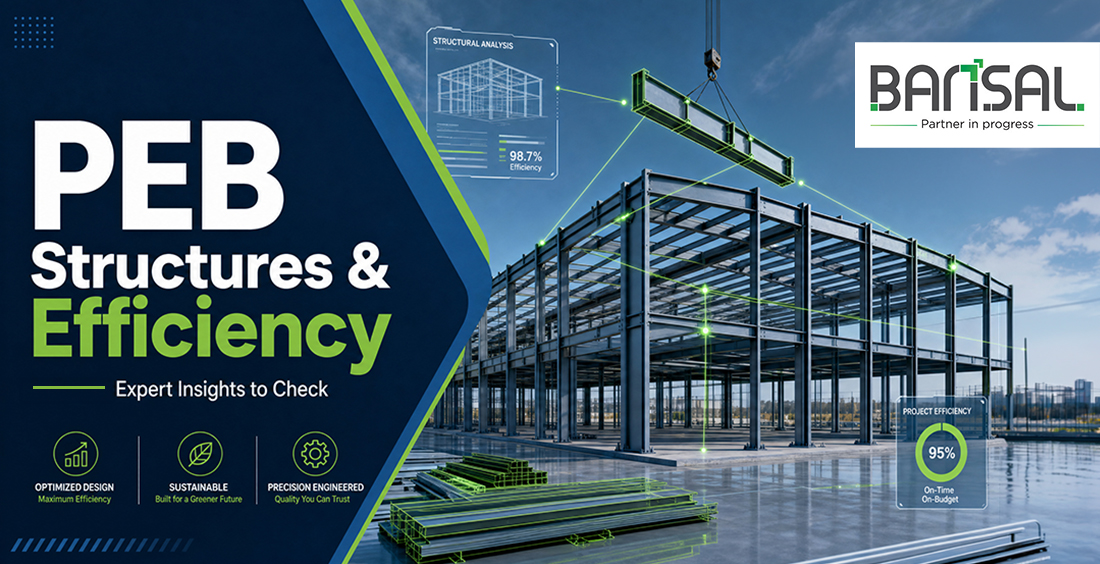
PEB structures and efficiency: Expert Insights to Check
Posted on: Jun 16, 2026
The industrial construction landscape is moving away from traditional masonry and cast-in-place concrete setups. Instead, project managers are heavily leaning into Pre-Engineered Buildings (PEBs). By engineering and fabricating 100% of the core structural parts inside a controlled factory before shipping them for a fast, bolt-together assembly, companies can slash deployment timelines by nearly 50%. This guide breaks down the essential components, design variations, and long-term cost benefits that make pre-engineered steel the definitive path forward.
Understanding the Framework: What is PEB Structure and How Does It Work?
If you walk through any booming industrial corridor or logistics park today, you will notice a rapid physical transformation. The dusty, chaotic scenes of pouring concrete and laying bricks are missing. In their place, massive industrial skeletons rise from the ground in just a matter of weeks.
So, what is peb structure exactly? Put simply, a Pre-Engineered Building (PEB) is a structural framework where the entire building is planned, structurally analyzed, and fabricated inside a controlled factory environment before any materials even touch the job site. Once production is complete, the pre-punched, clearly coded components are shipped directly to the location for a fast, bolt-together assembly.
Traditional construction methods are notoriously vulnerable to unpredictable material waste, labor shortages, and seasonal weather delays. Shifting the heavy engineering away from a messy field and into an automated manufacturing plant turns infrastructure into an exact science. Instead of fabricating on-the-fly, a PEB operates like a precision-engineered kit of parts, allowing civil teams and assembly crews to work with maximum predictability.
The Building Blocks: Core PEB Structure Components You Need to Know
To understand why leading infrastructure planners treat these steel buildings as high-performance assets, we need to look deep into their anatomy. A reliable building isn’t just a collection of random steel sheets; it is an interconnected ecosystem composed of three critical peb structure components:
1. Primary Structural Framing
This acts as the robust skeletal backbone of the entire building. It includes heavy-duty built-up "I" sections, primary columns, and main rafters that bear the primary weight loads. These components are mathematically tapered by software to be wider where the stress is highest and leaner where it isn't, distributing forces uniformly down to the concrete foundation without wasting raw steel.
2. Secondary Structural Members
Acting as the secondary support and stabilization layer, this segment features cold-formed "C" and "Z" purlins, girts, and structural eave struts. These pieces run perpendicular to the main frames. They provide essential longitudinal stiffness, block lateral buckling under heavy stress, and act as secure anchoring points for the outer walls and roof panels.
3. Roofing, Cladding, & Accessories
The protective outer skin of the structure utilizes high-tensile metal profiles and standing seam systems for 100% leak-proof performance. To manage internal temperatures in tropical climates, manufacturers integrate insulated sandwich panels (such as PUF blocks). Accessories like custom turbo-vents and ridge ventilators are seamlessly added to keep air moving naturally without spiking electricity bills.
Exploring the Flexibility: Common Types of PEB Structures
There is a stubborn myth in commercial real estate that pre-engineered steel means getting a boring, rigid, look-alike box. In reality, modern structural engineering provides incredible spatial freedom. Depending on your operational requirements, floor layouts, and clear span needs, there are several distinct types of peb structures deployed in the field:
- Clear Span Structures: This layout features zero internal pillars or columns, stretching up to 60 meters or more without obstruction. It is an absolute game-changer for large logistics hubs, automated fulfillment centers, and aircraft hangars that require wide, open spaces for vertical racking and heavy machinery movement.
- Multi-Span Rigid Frames: For massive factories or manufacturing units where unobstructed width isn't a strict mandate, internal columns are introduced. This allows the building to scale horizontally over vast acres while maintaining absolute structural reliability.
- Lean-To Frames: Perfect for expansions, a lean-to structure relies on an adjacent, existing framing system for partial support. It is a cost-effective way to add office spaces, utility rooms, or loading docks to a warehouse down the line.
- Multi-Story Systems: Utilizing integrated mezzanine floors, these systems maximize vertical space. They are ideal for administrative offices embedded within heavy industrial plants or multi-level storage yards.
Why Efficiency Matters: Expert Insights on the Sustainability of PEBs
Connecting the structural physics back to corporate balance sheets reveals why understanding what is peb structure technology matters so much to modern project managers. The returns on choosing factory-engineered steel over concrete are massive:
- Parallel Processing Slashes Timelines: In the B2B world, prolonged construction schedules mean idle capital. Working with a pre-engineered workflow gives you a unique logistical edge. While your civil crews are on-site digging trenches and curing foundations, the factory is simultaneously rolling out your primary and secondary frames. The moment the concrete is dry, the building kit arrives, trimming total project commissioning timelines by up to 50%.
- Maximized Life-Cycle Cost Savings: Because sophisticated software calculates the exact stress thresholds, the weight of the steel is perfectly optimized. A lighter structural mass means you can scale back the depth, size, and overall expense of the concrete foundation work. Combine this with lower on-site labor hours and zero raw material wastage, and the initial return on investment improves drastically.
- Future-Proof Scalability: Your building needs to be able to grow alongside your commercial footprint. Because a PEB is fundamentally a bolted assembly rather than a monolithic concrete mass, expanding it is remarkably straightforward. If you need more floor space five years down the line, an engineering team can simply bolt on additional framing bays without shutting down your ongoing production lines.
Conclusion: Making the Shift to High-Efficiency Infrastructure
Building an industrial asset that survives for generations is never a matter of luck; it is always the logical outcome of meticulous material science and automated manufacturing control. By understanding how the core components and diverse configurations work together, project managers can unlock unprecedented operational speed, safety, and flexible strength.
At Bansal Poles, we approach pre-engineered structural development with over 40 years of heavy industrial engineering heritage. Backed by ISO-certified quality protocols and premium raw steel, we remove the guesswork from complex execution risks.
Ready to streamline your upcoming development? Explore Bansal Poles Pre-Engineered Building Solutions and see how precision engineering accelerates your business timeline.
Frequently Asked Questions
A PEB structure is a building system where all steel components are fully designed and manufactured inside a factory before being bolted together on-site. It is preferred over traditional concrete because it eliminates material waste, ensures precise quality control, and cuts total construction timelines in half through parallel processing.
The anatomy of a PEB consists of primary framing (built-up tapered "I" sections, columns, and rafters), secondary framing (cold-formed "C" and "Z" purlins, girts, and eave struts), and the outer cladding (high-tensile metal roofing profiles, insulated panels, and natural ventilators).
Yes, absolutely. Professional manufacturers design all structural frames mathematically using advanced software to meet local wind load and seismic criteria specified in national safety codes (like IS 875). Steel's inherent flexibility allows it to perform remarkably well under high wind pressures and sudden environmental shifts.
Yes, flexibility is one of its biggest advantages. Since the primary framing members and secondary elements are fixed together using high-strength structural bolts rather than permanent site welds or concrete pours, they can be easily dismantled, extended with new bays, or relocated as your operations scale.
PEB designs optimize the exact quantity of steel required via computerized design systems, virtually eliminating field material waste. Additionally, the lighter structural framework scales down concrete foundation costs, and the fast bolt-on assembly significantly cuts down on manual labor hours.

Comments (0)
Post Your Comment