
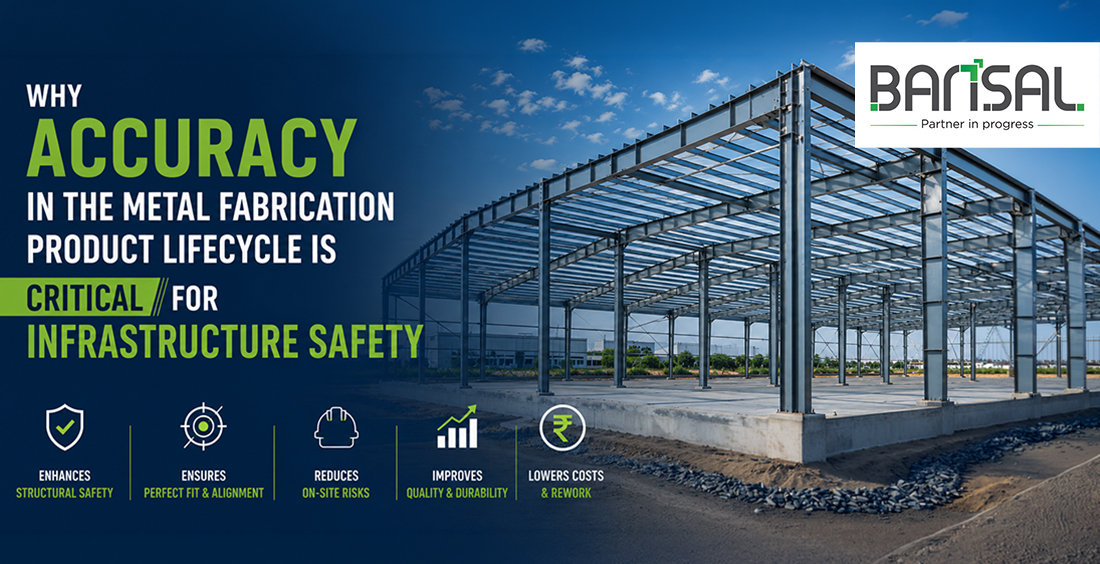
Why Accuracy in the Metal Fabrication Product Lifecycle is Critical for Infrastructure Safety
Posted on: Jun 02, 2026
Introduction: The High Stakes of Precision in a Metal Fabrication Product
When we look at massive industrial setups, utility grids, or public transit systems, it is easy to focus on the sheer scale of the engineering. But if you talk to any structural engineer with boots on the ground, they will tell you that the survival of these massive structures depends entirely on things you can barely see with the naked eye. In high-stakes B2B infrastructure, the margin for error isn't slim - it is effectively zero.
A single metal fabrication product, whether it is a high-load heavy duty bracket or a structural column, acts as a crucial link in a very large safety chain. When a manufacturer cuts corners or allows tiny dimensional deviations during fabrication, they aren't just delivering a slightly imperfect component; they are embedding a ticking time bomb directly into public infrastructure. A discrepancy as tiny as a couple of millimeters might seem harmless on a factory floor, but when you subject that part to cyclical stress, gale-force wind loads, or thousands of tons of hydraulic pressure, that minor flaw quickly scales into a catastrophic failure.
Material Integrity: Starting with High-Grade Metal Product Standards
You cannot fabricate a safe, reliable structure if you begin with compromised ingredients. True structural accuracy doesn't start at the cutting table - it begins the exact moment raw materials are sourced and audited. Every industrial-grade metal product must strictly comply with rigorous national and international material specifications to ensure long-term viability.
In our diverse and often brutal Indian climate, low-grade or non-certified alloys are a massive liability. If raw steel contains internal chemical impurities or uneven carbon distribution, its mechanical properties become completely unpredictable. Over time, environmental predators like high coastal humidity or intense seasonal thermal cycles will exploit these hidden weak spots. This leads to accelerated corrosion and early micro-cracking, causing the metal to grow brittle long before its intended design life concludes. Ensuring uncompromising material integrity at the very beginning of the lifecycle is our absolute first line of defense against structural fatigue.
Engineering Precision: Designing a Fail-Safe Metal Fabrication Product
Before a single spark flies or any heavy machinery hums, a structural component lives entirely inside digital blueprints. Transforming a raw concept into a highly reliable, fail-safe metal fabrication product requires an immense amount of computational precision during the initial design phase.
Modern industrial engineering completely discards basic guesswork by utilizing advanced CAD (Computer-Aided Design) and CAM (Computer-Aided Manufacturing) workflows. These sophisticated digital environments allow engineers to perform complex finite element analyses and rigorous structural load calculations. By simulating severe real-world conditions, designers can optimize weight distribution, calculate precise stress thresholds, and establish non-negotiable tolerances. This early lifecycle stage ensures that when the physical component is finally integrated into large-scale infrastructure, it acts as a reliable asset engineered to absorb real-world stress smoothly.
Manufacturing Accuracy: How Every Metal Product Impacts Public Safety
Once the digital blueprints are locked in, the project moves to the factory floor, where raw mathematics meets heavy machinery. This transition is where manufacturing accuracy directly impacts the safety of thousands of people every single day. Think about the high-stress demands placed on high mast poles, traffic gantries, or transmission towers. Every single structural metal product used in these applications must be executed flawlessly.
Precision cutting, high-penetration robotic welding, and accurate computerized bending are completely mandatory. If a structural connection is poorly aligned, or if a critical weld contains tiny gas pockets, the internal physics of the entire tower changes. Instead of distributing heavy wind or seismic loads uniformly across its structural skeleton, the force concentrates heavily onto that single flawed joint. Maintaining strict, non-negotiable tolerance levels during physical production is the only way to ensure that these large public structures remain safely grounded through severe storms and unpredictable environmental shifts.
Quality Control: Stress Testing the Metal Fabrication Product Lifecycle
A reliable manufacturing process is nothing without an equally strict validation process. To guarantee absolute compliance with international safety codes, a high-performance metal fabrication product must pass through a gauntlet of rigorous quality control checks before it is cleared for field installation.
This quality assurance phase relies heavily on Non-Destructive Testing (NDT) methodologies, such as ultrasonic inspections and magnetic particle testing, which scan the deep interior of metal components without altering their structural integrity. Furthermore, detailed galvanization thickness checks are vital to confirm that the anti-corrosive zinc shield is uniform and completely free of pinholes. This relentless, multi-stage validation ensures that every finished piece leaving the assembly line is fully traceable, legally compliant, and completely optimized to withstand decades of heavy operation.
Conclusion: Reliability Starts with a Precision-Engineered Metal Product
Building infrastructure that endures for generations is never a matter of luck; it is always the direct result of controlled, meticulous engineering. At Bansal Poles, we recognize that every single metal product we fabricate serves as the backbone for critical industrial networks. We prioritize absolute accuracy across every single stage of the product lifecycle - from strict raw material sourcing to advanced digital design and automated manufacturing.
By combining over 40 years of industrial engineering heritage with ISO-certified precision and strict adherence to national safety codes, we provide corporate project managers and procurement teams with complete operational confidence. When you are planning large-scale developments, you cannot afford to treat structural integrity as a variable. Choose a partner who treats lifecycle precision as an absolute mandate.
Ready to fortify your upcoming project? Explore our heavy-duty industrial solutions and see how our precise engineering accelerates rapid development: Explore Bansal Poles Pre-Engineered Building Solutions.
Frequently Asked Questions
Even a tiny deviation of a few millimeters can disrupt how structural loads are distributed across a building or tower. Under severe conditions like high wind speeds or seismic shifts, these minor errors cause immense stress concentration on joints and bolts, leading to sudden structural buckling or catastrophic failure.
Raw material standards guarantee that the steel has the correct chemical composition and mechanical strength. If you use uncertified, low-grade alloys, the component is highly prone to hidden internal defects, which cause the metal to rust rapidly, become brittle, and fail prematurely under environmental stress.
CAD and CAM workflows allow engineering teams to create highly accurate 3D models and run complex stress simulations before physical manufacturing begins. This eliminates manual drafting mistakes, optimizes structural ribbing, and ensures that the final component fits together perfectly on the job site without requiring hazardous on-the-fly modifications.
NDT involves advanced inspection techniques like ultrasonic, radiographic, or magnetic particle testing. These methods allow quality control teams to look deep inside a welded joint or heavy plate to find hidden air pockets or micro-cracks without damaging or weakening the component itself.
An ISO 9001:2015 certification guarantees that the manufacturer follows a highly standardized, closely audited Quality Management System. For procurement managers, this provides full material traceability, exceptional batch-to-batch consistency, and complete assurance that every structural component strictly satisfies national safety guidelines.

Comments (0)
Post Your Comment